
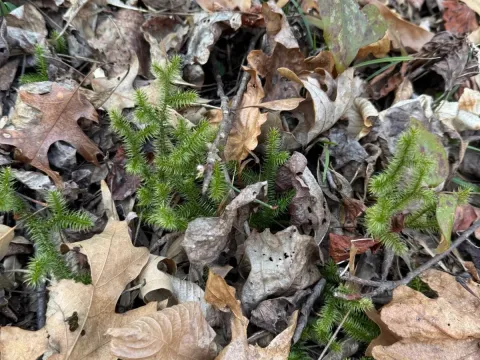
Lycopodium
Lycopodium
Lycopodium is a perennial evergreen spore-bearing herbaceous plant belonging to the Lycopodiaceae family. It is an ancient relict species that has retained the appearance of its ancestors that dominated the planet millions of years ago.
What the section contains


Lycopodium
To grow properly, the crop requires specific conditions: high humidity of air and soil, as well as significant shade. The plant prefers acidic soils typical of coniferous forests and reacts poorly to direct exposure to intense sunlight.
In the natural environment, Lycopodium forms long creeping shoots that take root in the ground cover. Reproduction occurs slowly, mainly through spores, which makes the crop's development cycle very long and sensitive to external anthropogenic factors.
The temperature regime for Lycopodium must be moderate. The crop reacts extremely negatively to drying of the substrate and sudden changes in humidity, so in agronomic terms, the plant is practically impossible to cultivate in open fields as a standard agricultural crop.
The primary economic use of Lycopodium is centered on the collection of its spores, known as lycopodium powder. In pharmacology and metallurgy, the spores are valued for their high hygroscopicity, which allows them to be used as a baby powder or molding material.
Lycopodium does not suffer from typical agricultural pests because it possesses a specific chemical composition. However, it is extremely vulnerable to the destruction of the forest ecosystem caused by logging or changes in the hydrological regime.
The main threat to Lycopodium is the direct destruction of its habitat. Soil contamination with heavy metals and changes in substrate acidity lead to rapid degradation of populations of this slow-growing plant.
Diseases in the usual agronomic sense are not characteristic of it. Rather, the danger is posed by fungal infections that occur when the natural balance of microflora in its growth areas is disturbed.
Due to the slow growth rate, any mechanical processing of the soil in Lycopodium growth areas leads to its death. The plant is unable to compete with fast-growing weeds if the density of the forest canopy is violated.
Given the extreme slowness of vegetation, the restoration of a population after a disturbance takes decades. That is why in many regions the collection of Lycopodium spores is strictly limited or completely prohibited by law.
The collection of spores, called lycopodium powder, is carried out at a strictly defined time when the strobili (cones) reach the stage of full maturity. This period usually falls at the end of summer or early autumn.
The harvesting process consists of carefully cutting off the cones with a sharp tool. It is important to avoid damaging the vegetative shoots, as the regeneration of Lycopodium occurs extremely slowly.
After collection, the cones are subjected to careful drying in shaded places with good ventilation. During the drying process, the natural shedding of spores occurs, which are then separated from plant residues by sifting.
Finished lycopodium powder is a yellowish, extremely fine, and volatile substance. Its physical properties require special storage conditions, excluding moisture and contamination with foreign impurities.
Large-scale harvesting requires compliance with environmental standards to prevent the complete disappearance of Lycopodium in collection areas. Modern agronomic methods are aimed not at large-scale farming, but at the rational management of these populations.