
Reference · Crops
Maple
Acer L.
Maple seeds should ideally be sown in the autumn, immediately after harvest, to allow for natural stratification in the soil throughout the winter months.
29
items
What the section contains
 Acer truncatum
 Bunge
Acer truncatum
Acer truncatum Bunge
 Amur maple
Acer tataricum L. subsp. ginnala (Maxim.) Wesm.
Amur maple
Acer tataricum L. subsp. ginnala (Maxim.) Wesm.
 Bigtooth maple
Acer grandidentatum Nutt.
Bigtooth maple
Acer grandidentatum Nutt.
 Box elder
Acer negundo L.
Box elder
Acer negundo L.
 Field maple
Acer campestre L.
Field maple
Acer campestre L.
 Freeman Maple
Acer xfreemanii A. E. Murray
Freeman Maple
Acer xfreemanii A. E. Murray
 Heldreich's maple
Acer heldreichii Orph. ex Boiss.
Heldreich's maple
Acer heldreichii Orph. ex Boiss.
 Hybrid maple Acer platanoides × Acer truncatum
hybrids between Acer platanoides L. and Acer truncatum Bunge
Hybrid maple Acer platanoides × Acer truncatum
hybrids between Acer platanoides L. and Acer truncatum Bunge
 Hybrids of Acer palmatum and Acer pseudosieboldianum
Hybrieds between Acer palmatum and Acer pseudosieboldianum
Hybrids of Acer palmatum and Acer pseudosieboldianum
Hybrieds between Acer palmatum and Acer pseudosieboldianum
 Italian maple
Acer opalus Mill.
Italian maple
Acer opalus Mill. subsp. Opalus
Italian maple
Acer opalus Mill.
Italian maple
Acer opalus Mill. subsp. Opalus
 Japanese maple
Acer palmatum Thunb.
Japanese maple
Acer palmatum Thunb.
 Japanese maple
Acer palmatum Thunb. subsp. amoenum (Carrière) H. Hara
Japanese maple
Acer palmatum Thunb. subsp. amoenum (Carrière) H. Hara
 Korean maple
Acer pseudosieboldianum (Pax) Kom.
Korean maple
Acer pseudosieboldianum (Pax) Kom.
 Long-stalk maple
Acer longipes Franch. ex Rehder
Long-stalk maple
Acer longipes Franch. ex Rehder
 Longipes maple
Acer longipes x Acer platanoides
Longipes maple
Acer longipes x Acer platanoides
 Montpellier maple
Acer monspessulanum L.
Montpellier maple
Acer monspessulanum L.
 Norway maple
Acer platanoides L.
Norway maple
Acer platanoides L.
 Opalus maple
Acer opalus Mill. subsp. obtusatum (Waldst. & Kit. ex Willd.) Gams
Opalus maple
Acer opalus Mill. subsp. obtusatum (Waldst. & Kit. ex Willd.) Gams
 Red maple
Acer rubrum L.
Red maple
Acer rubrum L.
 Semenov maple
Acer tataricum L. subsp. semenovii (Regel & Herder) A. E. Murray
Semenov maple
Acer tataricum L. subsp. semenovii (Regel & Herder) A. E. Murray
 Shirasawa maple
Acer shirasawanum Koidz.
Shirasawa maple
Acer shirasawanum Koidz.
 Silver maple
Acer saccharinum L.
Silver maple
Acer saccharinum L.
 Sugar maple
Acer saccharum Marshall
Sugar maple
Acer saccharum Marshall
 Sycamore maple
Acer pseudoplatanus L.
Sycamore maple
Acer pseudoplatanus L.
 Tatar maple aidzuense
Acer tataricum L. subsp. aidzuense (Franch.) P. C. DeJong
Tatar maple aidzuense
Acer tataricum L. subsp. aidzuense (Franch.) P. C. DeJong
 Tatarian maple
Acer tataricum L.
Tatarian maple
Acer tataricum L.
 Trident maple
Acer buergerianum Miq.
Trident maple
Acer buergerianum Miq.
 Vine maple
Acer circinatum Pursh
Vine maple
Acer circinatum Pursh
Marketplace
Products in this section · 1
Maple
For spring sowing, seeds require artificial stratification at temperatures between 1 and 5 degrees Celsius for a period of 60 to 120 days.
The seeds should be planted at a depth of 3 to 5 centimeters in well-drained soil to prevent dehydration and protect them from surface environmental stressors.
Seedlings are best transplanted during the early spring before the buds break or in the late autumn after the leaves have fallen from the trees.
When establishing a plantation, ensure proper spacing is maintained to provide each tree with adequate sunlight and soil nutrients for long-term growth.
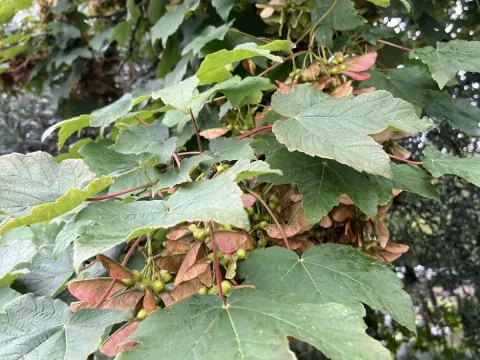
Maple belongs to the Sapindaceae family and is a versatile genus comprising various tree and shrub species native to the Northern Hemisphere.
These trees prefer deep, fertile, and moist soils with excellent drainage, as they are susceptible to root diseases in waterlogged or swampy ground.
While maples are generally adaptable, they perform best in temperate climates and require protection from harsh, drying winds and excessive air pollution.
The optimal pH level for most maple species ranges from slightly acidic to neutral, which ensures the availability of essential minerals for healthy development.
Young maples are often shade-tolerant, but as they mature, they require full sun exposure to maximize their growth rate and branch development.
Maple is commercially valued for its dense, fine-grained wood, which is extensively used in high-quality furniture, flooring, and musical instrument production.
The sap of specific maple species, particularly the sugar maple, is harvested to produce maple syrup, representing a significant agricultural industry.
Maple trees serve as excellent pollinators in early spring, making them highly beneficial for beekeeping operations in forested or rural areas.
The biomass production of maples is critical in reforestation efforts, helping to stabilize soil and prevent erosion in diverse ecological zones.
In landscape management, maples are highly prized for their aesthetic value and their ability to act as natural windbreaks around agricultural fields.
Verticillium wilt is one of the most severe threats to maple trees, often causing sudden wilting and death of branches by attacking the vascular system.
Powdery mildew is a common fungal infection that covers leaves in a white powdery substance, which can be managed with proper fungicide application.
Various insects, such as leaf-eating beetles, aphids, and borers, can significantly weaken the tree's structure and overall health over time.
Regular monitoring for signs of infestation, such as holes in the bark or discoloration of leaves, is vital for maintaining a healthy maple stand.
- Regular pruning of diseased or dead wood to stop infection
- Use of appropriate insecticides to control leaf pests
- Monitoring soil moisture to avoid root rot development
- Application of balanced fertilizers to support immunity
- Selecting locally adapted and disease-resistant maple species