
Japanese maple
Acer palmatum Thunb. subsp. amoenum (Carrière) H. Hara
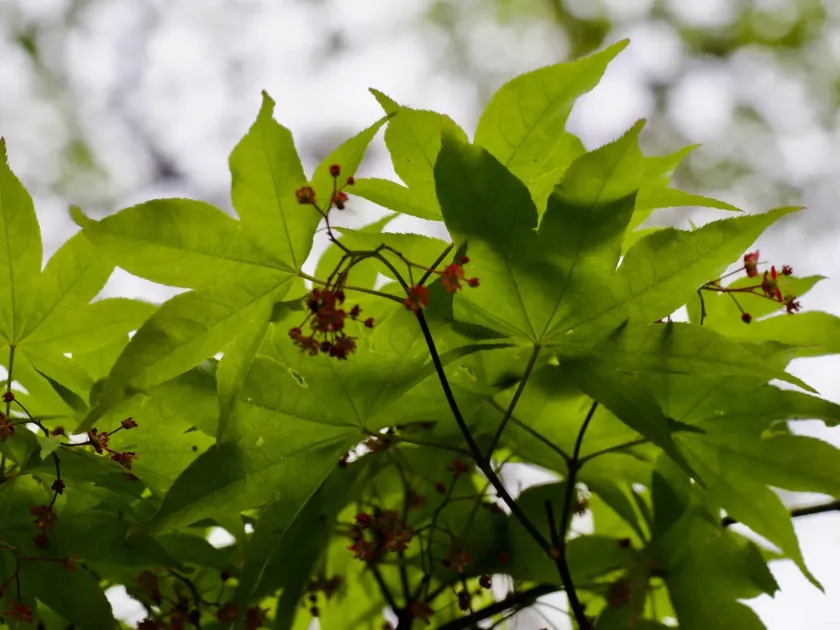
Description
Growing requirements
Japanese maple (Acer palmatum) is a member of the Sapindaceae family. Originating from Japan, Korea, and China, it has become a staple of temperate climate gardens worldwide due to its elegant foliage and diverse growth forms.
Successful cultivation requires soil that is well-drained, rich in organic matter, and slightly acidic. It is essential to avoid sites prone to waterlogging, as the roots are highly susceptible to rot when deprived of sufficient aeration.
The plant thrives in partial shade, especially in warmer regions where direct sunlight can scorch its delicate, deeply lobed leaves. Protection from drying winds is necessary to maintain the plant's aesthetic integrity and prevent dehydration of the branch tips.
Consistent soil moisture is vital during the growing season. Applying organic mulch around the base of the plant helps to preserve moisture, suppress weeds, and keep the roots cool, which is critical for long-term survival in garden conditions.
In terms of хозяйственное (economic/ornamental) use, the Japanese maple is primarily grown for its landscape value. It is widely used in oriental-style garden designs, as a focal point in borders, or as a classic subject for the art of bonsai cultivation.
Main diseases and pests
Verticillium wilt is a serious soil-borne fungal disease that affects the vascular system of the Japanese maple. It causes leaves to wilt and die back, often appearing on one side of the plant; unfortunately, there is no cure for this systemic infection.
Powdery mildew often manifests during humid seasons, covering leaves in a white, powdery fungal growth. While rarely fatal, it can significantly affect the plant's appearance and reduce its photosynthetic capacity during the late summer months.
Spider mites are common pests that thrive in dry environments. They cause stippling and discolouration of the foliage, eventually leading to leaves drying out and falling early, which requires regular monitoring and treatment with miticides.
Aphids tend to cluster on young, tender growth during the spring. By feeding on sap, they cause leaf curling and serve as vectors for secondary infections; effective control is achieved through biological or chemical pest management strategies.
Stem cankers may appear on branches due to stress or mechanical damage. Pruning back to healthy, infection-free tissue is the recommended intervention, ensuring tools are sanitized to prevent the spread of the pathogen between different specimens.