

Description
How to tell it apart
Bermuda grass (Cynodon dactylon) is a perennial grass species belonging to the Poaceae family. It is recognized for its creeping growth habit and dense mat-forming capability.
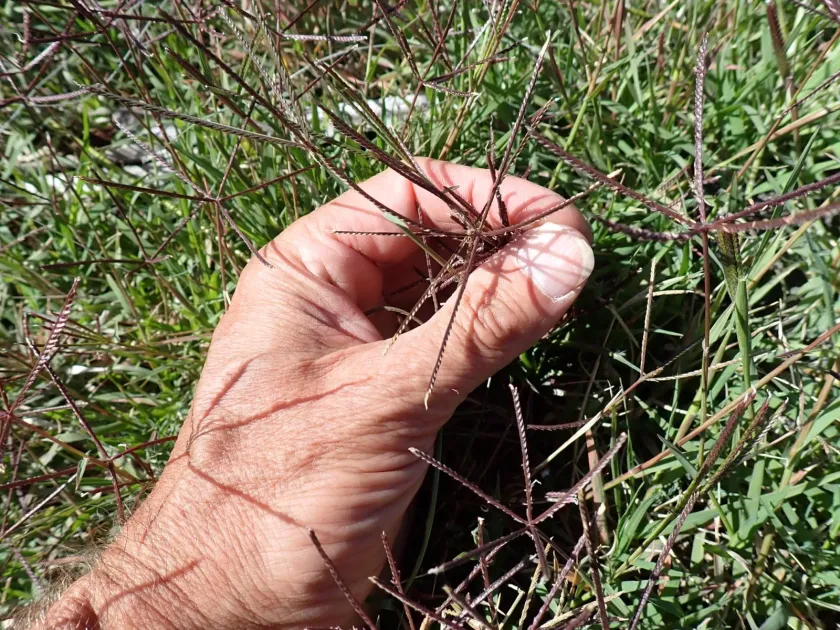
The stems of the plant are slender, flattened, and branched, often spreading across the soil surface and rooting at every node to form a complex network.
The leaves are typically grey-green in color, flat, and narrow, with a distinct rough texture along the edges that helps identify the species from other grasses.
The inflorescence consists of a finger-like cluster of 3 to 7 spikes emerging from a single point, which is a key diagnostic feature of this plant.
Its root system is extremely aggressive, featuring both deep-growing taproots and extensive lateral rhizomes that can reach depths of up to half a meter.
Where it grows
Bermuda grass is highly adaptable to various environments but prefers warm, sunny, and moist conditions, making it prevalent in tropical and temperate regions.
It thrives in open fields, orchards, vineyards, and irrigated crop lands, where it quickly outcompetes native vegetation due to its fast growth rate.
The plant is commonly found along roadsides, irrigation ditches, and areas with disturbed soil, where it can easily establish itself through vegetative propagation.
In irrigation-heavy agriculture, Bermuda grass can become a major nuisance, spreading along water channels and moving into crop rows very rapidly.
It displays remarkable drought tolerance, allowing it to survive in harsh conditions where other plants might fail, further cementing its role as a persistent weed.
Harm it causes
The primary harm caused by Bermuda grass is its intense competition for nutrients, light, and water, which severely stunts the development of crops like maize and cotton.
Its complex network of rhizomes creates a dense layer in the soil, making it extremely difficult for young crop roots to penetrate and establish effectively.
Bermuda grass acts as a host for various agricultural pests and viral diseases that can significantly damage yield quality and overall plant health.
In high-density infestations, the weed can completely overwhelm crops, leading to total yield loss if not managed during the early stages of the growing season.
Mechanical operations, such as plowing or cultivating, are often impeded by the tough, fibrous root system of the weed, increasing equipment wear and fuel consumption.
How to control
Cultural control involves repeated deep tillage to expose rhizomes to the sun and wind, which desiccates the plant material and prevents regrowth.
Winter plowing is an effective strategy in colder regions, as it brings the rhizomes to the surface where they are killed by freezing temperatures.
Chemical control usually requires systemic non-selective herbicides like glyphosate, applied when the plant is actively growing to ensure translocation to the roots.
For selective control in broad-leaf crop fields, grass-specific herbicides (graminicides) are recommended to eliminate the weed without harming the main crop.
- Implementation of crop rotation cycles to disrupt the growth cycle of the weed.
- Manual removal of root fragments in gardens or small agricultural plots.
- Application of mulching techniques to deny the plant the sunlight it requires for photosynthesis.
Content graph
Connections · Bermuda grass
Most often together:
Marketplace
Products · 21


Pantera
Кемарк КФТ, Угорщи (на замовлення Кемтура Корпорейшн, США)на
Herbicides
1
0
·
3.4K
26 offers
8.98 €per 1 l
Buy


Bagira Super
Ф.Меатон Лімітед, Лондон, Великобританія.
Herbicides
1
2
·
2.8K
5 offers
4.29 €per 1 l
Buy


Agil 100
F.A.GAN Chemical Manufacturers Ltd. Israel, member
Herbicides
0
0
·
2.3K
8 offers
5.03 €per 1 l
Buy


Selenit
«Нанджин Ессенс Файн-Кемікал Ко. Лтд» (Китай)
Herbicides
0
0
·
1.4K
4 offers
12.06 €per 1 l
Buy


Antizlak
Jiangsu Good Harvest-Wayen Agrochemical Co., Ltd.
Herbicides
0
0
·
1K
3 offers
20.63 €per 1 l
Buy


Fusilade Forte 150 EC c.e.
Сингента Лімітед, Хаддерсфільд,Великоб-ританія
Herbicides
0
0
·
37
4 offers
27.56 €per 1 l
Buy


Biology
Taxonomy
- Latin name
- Cynodon dactylon
- Family
- Многолетние злаковые