
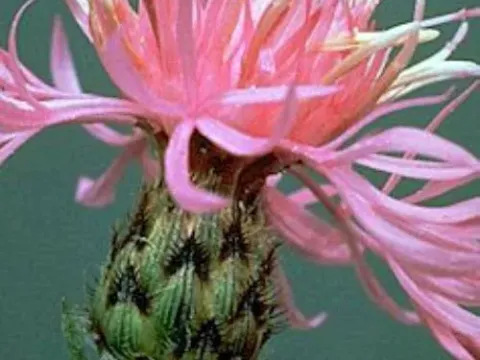
Spotted knapweed
Centaurea maculosa
Spotted knapweed (Centaurea maculosa) is a member of the Asteraceae family. It is a biennial or short-lived perennial taprooted plant that forms a rosette of leaves in its first year and develops tall, flowering stems in its second year.
What the section contains
Spotted knapweed
The stems are erect and highly branched in the upper part, typically reaching heights of up to 1.2 meters. Its leaves are deeply divided and display a grayish-green color due to fine pubescence, which is a distinctive visual characteristic.
The inflorescences are solitary flower heads located at the ends of branches. The flowers are usually pinkish-purple or lavender, though white forms can occasionally be found, making the plant recognizable in field borders.
The most reliable identification feature is the involucre of the flower heads; the bracts have dark, nearly black tips that resemble spots, giving the plant its common name and helping differentiate it from related species.
The plant features a deep taproot system, which enables it to persist in dry environments and makes mechanical eradication difficult, as the plant can easily regrow from root fragments if not removed completely.
Spotted knapweed prefers open, sunny locations with well-drained soils. It is commonly found along roadsides, disturbed areas, pasture lands, and abandoned fields, acting as a source for spreading into productive agricultural zones.
In cropping systems, it poses a significant threat to cereals, legumes, and perennial grasslands. Due to its invasive nature, it can rapidly encroach upon field edges, forming dense stands that outcompete cultivated crops for space.
The plant is highly adaptive to various soil types, including poor, sandy, or rocky conditions where other plant species may struggle to establish, allowing it to dominate areas with little competition.
It is particularly problematic in rangelands and hayfields, where it quickly colonizes areas with sparse vegetation, significantly reducing the grazing value of the land and displacing desirable forage species.
Rapid expansion is often observed in temperate regions, where the plant utilizes its effective seed dispersal mechanisms and competitive rooting depth to establish dominance in diverse habitats.
The primary harmful impact of spotted knapweed is its ability to outcompete crops for essential water and soil nutrients. This intense resource competition leads to substantial yield losses in grain and forage crops.
The plant produces allelopathic substances that are released into the soil through its roots. These chemicals inhibit the germination and growth of neighboring native plants and crops, effectively creating a sterile zone around the infestation.
In livestock production, spotted knapweed reduces the quality of pasture. It is generally unpalatable to cattle and other grazing animals, leading to inefficient utilization of available forage and overall degradation of pastures.
The presence of the plant in fields interferes with harvesting operations. Its tough, woody stems can clog harvesting equipment, increasing downtime and the cost of processing the harvested material due to contamination.
With a high seed production rate per plant, a single infestation can lead to a rapid spread over large areas, making early detection and intervention critical for effective field management.
Agronomic control methods include deep plowing and cultivation, which help to sever the taproot and prevent the plant from flowering. Maintaining clean field margins is essential to prevent primary seed dispersal.
Proper crop rotation and maintaining a dense, healthy crop canopy are effective strategies to shade out spotted knapweed, as the seedlings are highly sensitive to competition for light during their establishment phase.
Chemical control is most effective when applied during the rosette stage. Systemic herbicides containing active ingredients like dicamba, 2,4-D, or MCPA have demonstrated success in suppressing the plant and reducing its spread.
Control efforts during the flowering stage are significantly less effective. If treatment is delayed until this point, higher application rates or herbicide tank mixes are required to achieve a satisfactory level of plant mortality.
Continuous monitoring of field edges and sensitive areas is vital for long-term management. Preventing seed set is the most important objective, as the seed bank can remain viable in the soil for several years if not managed.