
Rattlebox
Daubentonia texana
Description
How to tell it apart
Rattlebox (Daubentonia texana, synonymous with Sesbania punicea) is a perennial shrub or small tree belonging to the Fabaceae family. It is recognized by its pinnately compound leaves and pendulous racemes of showy, red to orange-red pea-like flowers.
The stems are erect and branched, reaching heights of up to 3 meters. Young stems may show slight pubescence, but they eventually become smooth and woody, making the plant look like a permanent landscape feature.
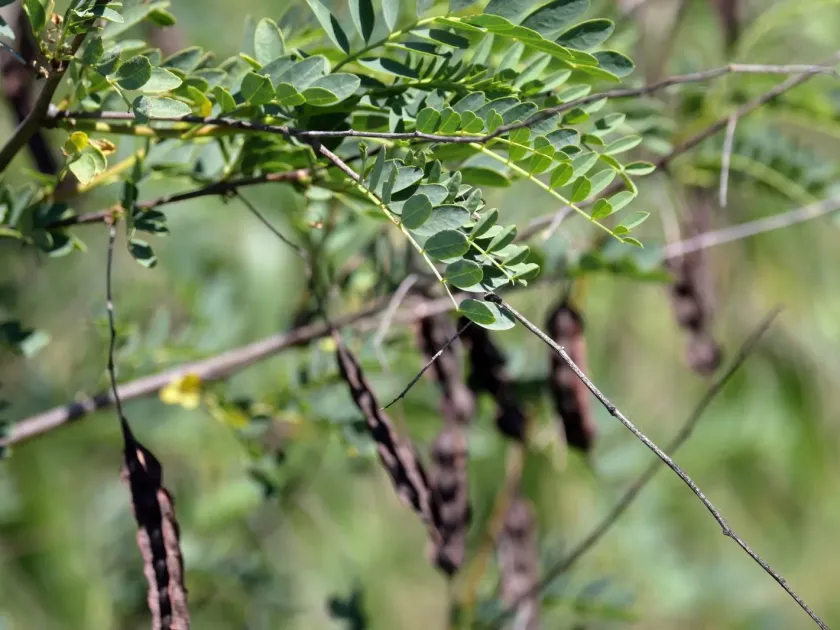
The fruit is a distinctive four-winged pod, which serves as a primary diagnostic characteristic. These pods are extremely persistent and remain attached to the branches long after the leaves have fallen, often rattling in the wind.
Seeds are dark, hard, and smooth, adapted for long-term survival in the soil seed bank. Their resilience allows them to germinate over several years, ensuring the plant's survival even after multiple weed control attempts.
The root system is robust and taproot-oriented, allowing it to penetrate deep into the soil. This structural adaptation provides exceptional drought tolerance and makes manual uprooting of mature plants physically demanding.
Where it grows
This weed prefers moist environments, often found along riverbanks, irrigation ditches, ponds, and low-lying areas in agricultural fields. It is a classic example of a riparian weed that exploits water movement for seed dispersal.
In agricultural settings, it typically colonizes irrigated cropland and poorly drained fields. Its ability to tolerate saturated soil conditions makes it a significant issue in areas with high water tables or flood-prone terrain.
It frequently invades field edges and fence rows, where it establishes dense colonies. From these refugia, the plant slowly expands into the cultivated area, increasing the labor required for field maintenance.
Abandoned farmland is particularly susceptible to rapid infestation by rattlebox. Without regular disturbance, it quickly forms thickets that effectively exclude other plants and alter the local soil moisture regime.
Disturbed sites, such as roadside verges and utility corridors, also act as sources for seed dispersal. Given its broad environmental tolerance, it can thrive in a variety of soil types, from sandy loams to heavier clays.
Harm it causes
The primary concern with rattlebox is its high toxicity. All parts of the plant, especially the seeds, contain toxic saponins and glycosides that are lethal to livestock, including cattle, sheep, and goats.
As a weed, it competes aggressively with crops for water, light, and soil nutrients. Its rapid vertical growth allows it to overtop and shade out young crop seedlings, significantly reducing potential yields.
Contamination of harvested grain with rattlebox seeds is a serious economic burden. Its presence in forage or hay makes the feed unsafe for livestock consumption, leading to potential loss of assets and veterinary expenses.
In irrigation systems, heavy growth of rattlebox restricts water flow and causes siltation. This necessitates frequent mechanical clearing of canals, increasing operational costs for the farm.
The plant disrupts standard field operations, creating physical barriers for farm machinery during spraying or harvesting. Furthermore, it outcompetes beneficial ground cover, reducing the overall biodiversity of the farmland.
How to control
Effective control requires an integrated approach starting with deep tillage to bury seeds and prevent seedling establishment. This is most effective when performed early in the growing season before flowering occurs.
Mechanical mowing is only a temporary measure and must be repeated frequently to be effective, as the plant will readily regenerate from the root crown if simply cut back once.
Chemical control involving systemic herbicides is necessary for established populations. Treatments with glyphosate are effective along field borders and non-crop areas, ensuring translocation into the root system.
In selective crop environments, herbicides targeting broadleaf weeds can be used, though success rates depend heavily on the growth stage of the weed. Mature plants are notoriously resistant to many standard applications.
- Regular field scouting to identify and remove small seedlings.
- Ensuring seed purity to prevent introduction to new fields.
- Establishing competitive cover crops to suppress weed emergence.
- Coordinated maintenance of drainage and irrigation ditches.
Taxonomy
- Latin name
- Daubentonia texana
- Family
- Прочие
- EPPO code
- DAOTE