
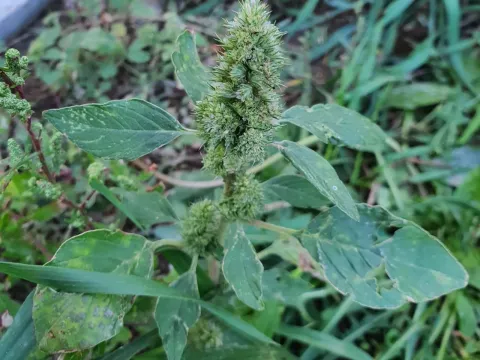
Spreading amaranth
Amaranthus patulus
Spreading amaranth (Amaranthus patulus) belongs to the Amaranthaceae family. It is an annual herbaceous plant characterized by a strong taproot system that reaches deep into the soil.
What the section contains
Spreading amaranth
The stem is erect, branched from the base, and can grow up to 100-120 centimeters in height. Its surface is often slightly pubescent and may show a reddish or purplish pigmentation.
Leaves are alternate, petiolate, and have a rhombic-ovate or lanceolate shape with entire margins. The apex is typically blunt with a small mucro in the notch.
The inflorescence consists of dense, spreading panicles located at the top of the stem and in the leaf axils. The small flowers are grouped into tight clusters, producing numerous seeds.
Seeds are very small, rounded, shiny, and dark brown to black. They possess high dormancy and can remain viable in the soil for several years.
This weed is widely distributed in temperate and subtropical zones. It thrives in open, sunny areas with fertile, well-drained soils, often colonizing agricultural lands.
Spreading amaranth is commonly found in row crops such as maize, sunflower, sugar beet, potatoes, and various vegetable crops where it can become highly invasive.
The plant frequently invades field edges, roadsides, and disturbed soils, spreading its seeds via wind, water, and agricultural equipment during cultivation processes.
Germination typically occurs in late spring and early summer when the soil temperature increases and moisture levels are sufficient for seedling emergence.
Due to its high environmental plasticity, this species adapts well to various soil types, ranging from sandy soils to heavier, nutrient-rich clay environments.
The primary damage caused by spreading amaranth is intense competition with crops for essential resources such as water, light, and soil nutrients, leading to yield loss.
Its rapid growth and sprawling canopy shade out young crops during the early stages of development, severely restricting the potential biomass of the main crop.
The weed rapidly depletes nitrogen, phosphorus, and potassium from the soil, which necessitates increased fertilizer application to compensate for the nutrient drain.
Furthermore, it serves as an alternative host for various crop-damaging pests and fungal pathogens, potentially increasing the disease pressure within the field.
In addition to physiological stress, high weed density at harvest time reduces harvesting efficiency, increases machine wear, and lowers the quality of the harvested produce.
Agronomic control practices include deep plowing, which effectively buries seeds too deep for emergence, and stale seedbed techniques to eliminate early flushes.
Inter-row cultivation is highly effective in row crops, providing mechanical destruction of young weeds and improving soil aeration for the main crop.
Crop rotation remains a fundamental strategy to disrupt the life cycle of the weed and minimize the accumulation of its seed bank in the soil over time.
Chemical control involves the application of selective herbicides, either pre-emergence or post-emergence, depending on the specific crop and weed growth stage.
- Use high-quality, certified seed free from weed impurities.
- Maintain weed-free field margins to prevent seed dispersal.
- Monitor fields regularly to identify new flushes of weeds.
- Implement proper fertilization strategies that favor the crop over weeds.