
Western ragweed
Ambrosia psilostachya
Description
How to tell it apart
Western ragweed (Ambrosia psilostachya) is a perennial, rhizomatous herbaceous plant belonging to the Asteraceae family. It is distinguished by its aggressive root system, which allows it to persist year after year.
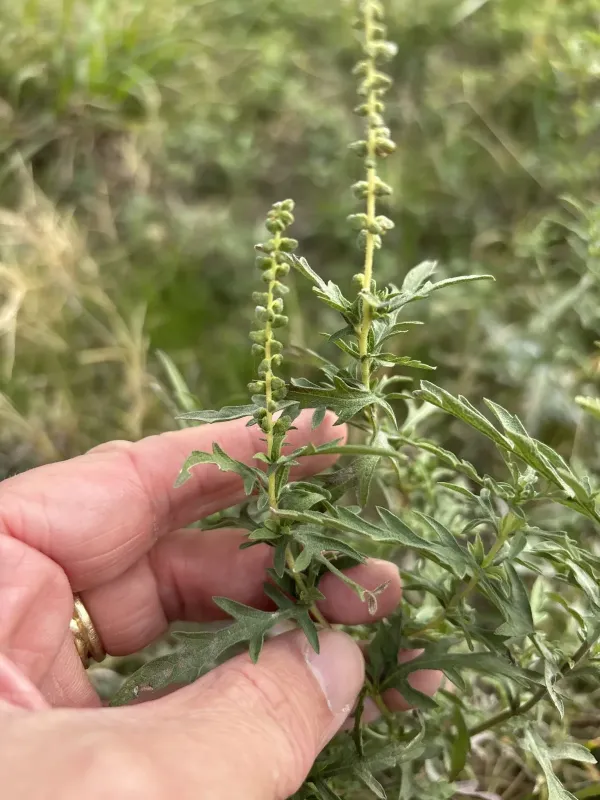
The plant grows to a height of 30 to 100 cm. Its stems are erect, branching, and covered in fine hairs. The leaves are alternate and pinnately lobed, displaying a deep green hue on the upper surface.
It is a monoecious plant, featuring separate male and female flowers. Male flowers are found in terminal spikes, producing large amounts of pollen, while female flowers are located at the base of the upper leaves.
Unlike its annual counterparts, Western ragweed propagates extensively through underground rhizomes. These root structures can extend deep into the soil profile, making the plant remarkably difficult to eradicate.
The plant exhibits rapid growth during the spring, utilizing stored energy in its rhizomes to gain a competitive advantage over seasonal crops early in the growing season.
Where it grows
Western ragweed thrives in open, sun-exposed environments. It is frequently found in disturbed habitats such as roadsides, abandoned fields, pastures, and along the edges of agricultural plots.
In agricultural settings, it is a significant nuisance in row crops, particularly corn, sunflowers, and soybeans. Its ability to tolerate various soil textures, including dry and salty soils, facilitates its spread.
The plant is highly adaptable to drought conditions, often colonizing areas where other vegetation struggles. This resilience makes it a persistent weed in arid and semi-arid agricultural regions.
Seed dispersal occurs primarily via wind and water, though human activity plays a major role. Contaminated farm machinery is a leading vector for transporting seeds into previously clean fields.
Once established, the weed tends to form dense, interconnected colonies. These patches expand annually through creeping roots, eventually displacing native species and crop plants.
Harm it causes
The primary economic damage caused by Western ragweed is severe competition for water and soil nutrients. This competitive pressure can lead to drastic yield reductions in infested fields.
Western ragweed exhibits allelopathic properties, meaning it releases chemicals into the soil that inhibit the germination and growth of neighboring plants, further reducing crop productivity.
The plant's pollen is a well-known allergen. During the flowering season, it poses a significant health risk to farm workers and local populations, contributing to widespread hay fever and respiratory issues.
The presence of ragweed seeds in harvested grain reduces the market grade and quality of the yield. This necessitates extra cleaning processes, which increase production costs for farmers.
In grazing pastures, Western ragweed is considered undesirable as livestock generally avoid it due to its bitter taste. Over time, it can dominate pastures, reducing the overall carrying capacity of the land.
How to control
Mechanical control involves deep tillage to disturb the rhizomes. However, simply fragmenting the roots can lead to further propagation, so intensive and frequent cultivation is necessary for depletion.
Crop rotation with competitive, dense-canopy crops is highly effective. Shading the soil prevents the light-loving Western ragweed from thriving, gradually weakening its rhizome energy reserves over several seasons.
Chemical control focuses on systemic herbicides applied to the foliage or directly to the roots. Glyphosate-based products are standard for fallow fields, aiming to translocate the toxin into the root system.
Targeted herbicide applications are essential during the early stages of weed growth. Producers must monitor fields closely, as mature plants develop a waxy cuticle that makes them more resistant to chemical uptake.
- Use of fallow management to exhaust root energy.
- Sanitation of equipment to prevent inter-field spread.
- Strategic use of cover crops to suppress weed emergence.
- Regular field scouting to identify and treat small infestations early.
Taxonomy
- Latin name
- Ambrosia psilostachya
- Family
- Прочие
- EPPO code
- AMBPC