
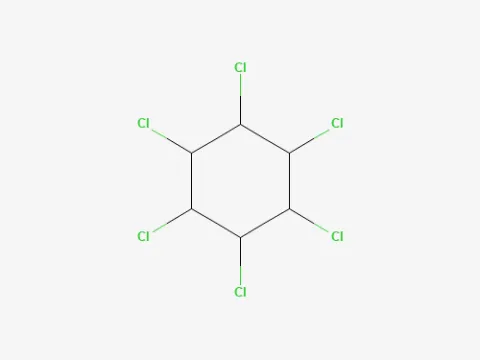
Hexachlorocyclohexane
Hexachlorocyclohexane (HCH) refers to a group of organochlorine chemical compounds that were historically used as powerful insecticides. The insecticidal properties are primarily attributed to the gamma isomer, commonly known as lindane, which acts as a potent nerve toxin.
What the section contains
Hexachlorocyclohexane
The mechanism of action involves disrupting the nervous system of insects by affecting the ion channels in nerve cell membranes. This causes rapid, irreversible paralysis of the target pest, leading to death shortly after contact or ingestion of the substance.
These chemicals demonstrate high environmental persistence, meaning they remain active for extended periods. This characteristic was once favored in agriculture for providing long-lasting control of pests without the need for frequent repeat sprayings.
HCH functions as a broad-spectrum insecticide, meaning it kills a wide variety of arthropods regardless of their beneficial or harmful roles in the ecosystem. This lack of selectivity is one of the primary reasons for its environmental damage.
Due to their high lipophilicity, these compounds easily cross biological membranes and accumulate in the fatty tissues of animals and humans. This bioaccumulation potential led to international regulatory actions to discontinue their production and agricultural use.
Hexachlorocyclohexane was widely applied to control soil-dwelling pests, including wireworms and white grubs, which cause significant damage to the root systems of various cereal and root crops. The chemical was often incorporated into the soil before sowing.
It was effective against a variety of leaf-eating insects, such as locusts, beetles, and caterpillars. Its use in seed treatment provided early-stage protection for seedlings, which was essential for maintaining proper crop density in infested areas.
The compound was also used in orchards to control various species of scale insects, mites, and moths. Its persistent nature allowed for continuous protection of fruits and tree bark during critical growth stages in the agricultural cycle.
In addition to plant protection, HCH was extensively used in veterinary medicine to treat livestock for infestations such as ticks, lice, and mites. However, the risk of residues in food products soon outweighed these benefits.
Currently, there are no approved agricultural applications for HCH. Global agriculture has shifted towards modern, biodegradable, and selective insecticides that do not pose such severe risks to biodiversity or human health.
The most significant limitation is that hexachlorocyclohexane is classified as a Persistent Organic Pollutant (POP) under the Stockholm Convention. Its production, trade, and use are strictly restricted or banned worldwide to protect human health and the environment.
These substances are hazardous due to their long-term stability, meaning they do not easily break down in nature. They leach into groundwater, migrate through the soil, and remain present in the food chain for generations after their last application.
Human exposure to HCH residues can lead to serious health issues, including chronic toxicity and reproductive system damage. Because of these risks, land previously treated with HCH requires careful monitoring and remediation before it can be safely used for food production.
Agricultural safety protocols prohibit the use of these compounds entirely. Modern agronomists are trained to manage potential legacy contamination rather than utilize the product, ensuring that residues do not end up in the food supply chain.
- Severe risks of bioaccumulation in mammals.
- High toxicity for aquatic organisms.
- Potential carcinogenic properties for humans.
- Long-term soil and water contamination.