
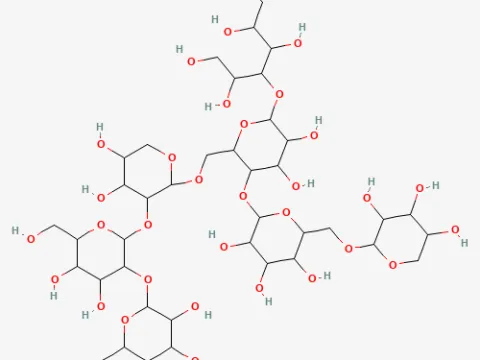
Heptamaloxyloglucan
Heptamaloxyloglucan belongs to the group of oligosaccharins, which act as vital signaling molecules within plant organisms. These compounds serve as endogenous elicitors, triggering complex defense mechanisms against environmental stress and pest attacks.
What the section contains
Heptamaloxyloglucan
The mechanism of action relies on the recognition of these molecules by specific receptors present on the plant cell surface. Once bound, the plant initiates a signaling pathway that leads to the synthesis of phytoalexins and defense-related proteins.
Unlike conventional contact fungicides, heptamaloxyloglucan does not act as a direct toxic agent against pathogens. Instead, it places the plant in a state of induced systemic resistance (ISR) or primed defense.
This biological strategy allows crops to respond much faster and more robustly when an infection actually occurs. It acts as an ecological alternative to synthetic chemical intervention for stimulating inherent immunity.
Furthermore, these substances strengthen plant cell walls, rendering them less susceptible to enzymatic degradation by pathogens attempting to penetrate the plant tissue.
This group of substances is primarily used to prevent a broad spectrum of fungal and bacterial diseases, including powdery mildew, leaf spot diseases, and various root rots.
It is suitable for use on vegetables, cereals, and ornamental plants. The efficacy is significantly higher when the product is applied preventively before the onset of disease pressure.
The product helps to mitigate damage caused by fungi that thrive in high humidity conditions, often found in greenhouse environments or during prolonged rainy seasons.
In addition to biotic stress, it helps improve the plant's non-specific resistance to abiotic factors such as drought stress and temperature fluctuations during sensitive growth phases.
By boosting the plant's overall health, it helps suppress vascular diseases that are otherwise extremely challenging to control with standard chemical products.
The preparation of the working solution must be carried out strictly according to the manufacturer's guidelines. Ensuring uniform coverage of the leaves is essential for optimal uptake and response activation.
Application timing should be aligned with critical plant growth stages, such as the seedling stage, flowering, or periods of rapid vegetative development.
Dosage rates vary depending on the specific application method, whether it is foliar spraying or drenching the soil. Following the recommended dosage ensures efficiency without resource waste.
Repeat applications may be necessary depending on the infection pressure and the speed of plant growth. Usually, an interval of 10 to 14 days is recommended for consistent defense.
Application during calm weather conditions is preferred, avoiding direct high-intensity sunlight, which can temporarily reduce the biological activity of the elicitors.
Heptamaloxyloglucan is not intended to replace traditional fungicides when an infection has already established itself at a severe level; it is best used as a prophylactic tool.
Compatibility with other pesticides and fertilizers should always be verified through a jar test before tank mixing to ensure there is no precipitation or chemical inactivation.
The biological nature of these products means that extreme environmental temperatures during application can negatively impact their efficacy and stability.
Store the product in a cool, dark, and dry environment to preserve the chemical integrity of the oligosaccharides throughout their shelf life.
Always adhere to standard safety protocols while handling, including the use of protective gloves, masks, and eye protection, even when dealing with biologically active agents.