
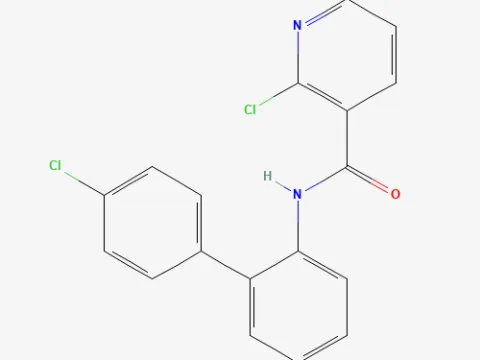
Boscalid
Boscalid belongs to the carboxamide (pyridine-carboxamide) chemical class. It is a systemic active ingredient that penetrates plant tissues and moves acropetally, providing protection for both treated areas and new growth.
What the section contains
Boscalid
Its mode of action is based on the inhibition of the succinate dehydrogenase enzyme within the mitochondrial complex II of the fungal respiratory chain. This blocks cellular respiration in the pathogen, halting energy (ATP) production and the synthesis of essential amino acids.
The substance exhibits high biological activity against a wide range of phytopathogens, including those that have developed resistance to other fungicide groups, such as strobilurins or benzimidazoles.
Boscalid effectively suppresses spore germination, germ tube elongation, and mycelial growth. It provides both preventative and curative properties, allowing for infection control at the initial stages of development.
Due to its high lipophilicity, the substance quickly anchors to the waxy leaf cuticle, ensuring excellent resistance to rainfall wash-off and a long duration of residual protective activity.
The primary use of Boscalid is for the control of key fungal diseases in vegetable, fruit, berry, and field crops.
The product is effective against pathogens from the ascomycete, deuteromycete, and basidiomycete classes. It is indispensable in protection programs for grapes, tomatoes, cucumbers, carrots, onions, cabbage, and stone fruits.
Major targets for application include:
- Gray mold (Botrytis cinerea) on various crops.
- Powdery mildew (various Erysiphaceae species).
- Alternaria blight (Alternaria spp.) on vegetables.
- Sclerotinia rot (white mold).
- Monilinia fruit rot and other decay types.
High selectivity allows Boscalid to be used in integrated pest management (IPM) programs without causing significant harm to beneficial entomofauna when used according to regulations.
Application rates for Boscalid vary depending on the crop, disease pressure, and the specific formulated product (often supplied in mixtures with other active ingredients, such as pyraclostrobin).
Standard application rates usually range from 0.3 to 1.5 kg of product per hectare. It is important to adhere to the maximum number of applications per season, generally limited to two or three, to prevent the formation of resistant strains.
Pre-harvest intervals (PHI) range from 7 to 30 days depending on the crop type and the intensity of the treatment.
When preparing tank mixes, a physical-chemical compatibility test is recommended, although Boscalid is generally compatible with most modern pesticides and micronutrients.
The optimal time for application is preventatively or at the first signs of disease, prior to widespread infection development.
The primary limitation is the risk of pathogen resistance development with frequent or exclusive use. Alternating with fungicides from different chemical classes is strongly recommended.
The product is considered low-toxicity to bees and beneficial insects, but standard safety protocols must be followed when handling pesticides to avoid drift onto adjacent non-target areas.
Disposal of product residues or wash water into water bodies is strictly prohibited, as the substance can negatively impact aquatic organisms if concentrations are high.
Personal protective equipment (PPE) for the respiratory system, skin, and eyes is mandatory when handling Boscalid.
Products containing this active ingredient should be stored in dry, well-ventilated facilities, inaccessible to unauthorized persons and animals, at temperatures specified by the manufacturer.