
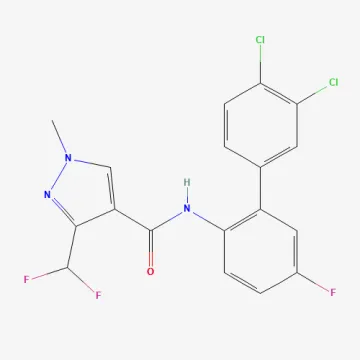
Bixafen
Description
Mode of action
Bixafen belongs to the pyrazole-carboxamide chemical class and acts as a potent systemic fungicide. Its primary mode of action is the inhibition of succinate dehydrogenase (SDHI) within the mitochondrial respiratory chain of target fungi, effectively cutting off energy production.
The substance possesses high lipophilicity, allowing it to penetrate the plant cuticle rapidly upon application. It exhibits translaminar movement, meaning it can migrate from the top side of the leaf to the underside, providing comprehensive coverage.
One of the key features of Bixafen is its long-lasting protective and curative effect. Once inside the plant tissue, it remains stable, providing a continuous barrier against incoming fungal spores for an extended period.
Beyond its fungicidal properties, Bixafen is known for its physiological benefits to the plant, often referred to as the "greening effect." It improves photosynthetic efficiency, which helps crops better withstand environmental stress and potentially increases yield.
To ensure long-term efficacy and mitigate the risk of resistance development, Bixafen is frequently formulated in mixtures with fungicides from other chemical groups, such as triazoles, creating a robust shield for crops.
What it targets
Bixafen is primarily utilized for the protection of cereal crops, such as wheat and barley, against a diverse range of fungal infections. It is highly effective in managing various leaf spot diseases that can compromise grain development.
The fungicide provides excellent control against Septoria tritici blotch, which is a major threat in intensive cereal production. It effectively inhibits both the germination and the growth of the pathogen's mycelium within the leaf tissue.
Tan spot (Pyrenophora tritici-repentis) is another key target for Bixafen. Its systemic action allows it to manage this pathogen throughout the growing season, especially when conditions are favorable for disease spread.
Rust diseases, including brown rust and yellow rust, are successfully suppressed by Bixafen. The application stops the pathogen from forming spores, significantly reducing the pressure on the crop canopy.
Additionally, the compound shows great results in controlling powdery mildew and net blotch in barley. Its ability to act as a preventative measure makes it a valuable tool in modern integrated pest management (IPM) programs.
Rates and timing
Application rates for Bixafen are determined by the specific formulation used and the level of disease pressure in the field. It is typically applied as a foliar spray to ensure uniform distribution across the crop canopy.
The optimal timing for application usually ranges from the stem elongation stage to the emergence of the flag leaf. Protecting the flag leaf is crucial as it contributes significantly to the final yield and quality of the harvest.
It is recommended to apply the fungicide at the first signs of disease or as a preventative measure in regions where environmental conditions favor fungal development. Timely intervention is key to achieving optimal results.
When preparing the spray mixture, one should consider the compatibility with other products like fertilizers or growth regulators. Conducting a jar test is a recommended practice to avoid any chemical antagonism in the tank.
Environmental conditions during application play a significant role in efficacy. Avoid spraying during high temperatures or strong winds to ensure that the droplets adhere correctly to the plant surface and reduce drift.
Restrictions
The handling of Bixafen requires strict adherence to safety protocols. Operators must wear appropriate personal protective equipment (PPE), including gloves, goggles, and respiratory protection, to prevent accidental exposure.
Bixafen can be harmful to aquatic ecosystems. Therefore, it is strictly forbidden to dispose of leftover spray solution near water bodies, wells, or drainage systems to prevent contamination of surface and groundwater.
Resistance management is a critical limitation when working with SDHI inhibitors. To maintain the long-term effectiveness of the active ingredient, users should avoid repeated applications and rotate Bixafen with other fungicide classes.
Strict observance of the pre-harvest interval (PHI) is mandatory for any product containing Bixafen. This ensures that the grain reaches the consumer without exceeding established maximum residue limits (MRLs).
Proper storage is essential for maintaining chemical stability. Products should be kept in original, tightly sealed containers in a cool, dry, and well-ventilated storage area, away from children, pets, and unauthorized personnel.
Status in the European Union
Approved in the EU
- CAS number
- 581809-46-3
- Category (EU)
- FU - Fungicide
- Approved from
- 01.10.2013
- Approval until
- 31.10.2027
- ADI
- 0.02 mg/kg bw/day
- ARfD
- 0.2 mg/kg bw
- AOEL
- 0.13 mg/kg bw/day
EU status is for reference only and does not replace national registration in your country.