
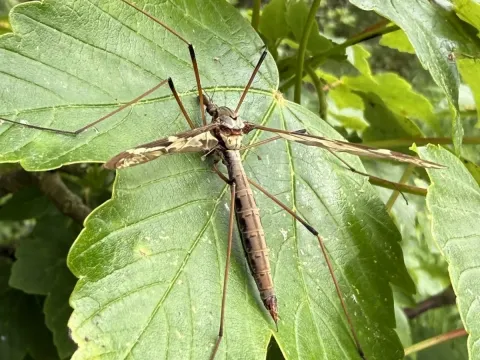
Marsh crane fly
Tipula maxima
The Marsh crane fly, scientifically known as Tipula maxima, is a large insect belonging to the family Tipulidae, order Diptera. It is frequently mistaken for a giant mosquito due to its long, spindly legs.
What the section contains
Marsh crane fly
Adults are brownish-grey in color and can reach a wingspan of up to 60 millimeters. Despite their size, they are harmless to humans as they do not possess the mouthparts necessary for biting.
The destructive phase of this insect is the larval stage, commonly referred to as a leatherjacket. These larvae have a greyish-brown, tough, cylindrical body with a hardened skin.
The life cycle typically spans one year, passing through egg, four larval stages, pupa, and adult. They are well-adapted to surviving in damp soil environments throughout their growth.
During winter, the larvae reside in the soil, often at a depth of 10-15 centimeters, which protects them from extreme cold while allowing them to resume feeding during warmer intervals.
Leatherjackets are polyphagous, meaning they feed on a vast range of plants including cereal crops, vegetables, berry bushes, and seedlings in nursery beds.
They cause significant economic loss by consuming the root systems of young plants, which results in the rapid wilting and eventual death of the affected crops.
Seedlings and young plants are particularly vulnerable, as their smaller root systems cannot withstand the heavy grazing damage caused by the larvae.
In humid conditions, larvae may move to the surface at night to feed on the crowns or stems of plants, leading to severe patches of dead vegetation in fields and lawns.
Heavy infestations can lead to significant thinning of crop stands, often requiring costly replanting and management interventions to restore productivity.
Adult flight usually commences in late spring and continues into early summer, which serves as the primary period for egg-laying across suitable agricultural areas.
Females prefer to deposit their eggs in damp soil or amongst dense vegetation, where humidity levels remain consistent to support early larval development.
Larvae are most active during the spring season as they grow rapidly in preparation for the pupation phase, posing the greatest risk to early-season growth.
A second period of heightened activity often occurs in autumn, when larvae feed intensively before entering a period of lower activity during the winter months.
Monitoring these seasonal activity windows is essential for agriculturalists, as timely intervention can significantly reduce the potential damage to vulnerable crops.
The most reliable sign of an infestation is the sudden wilting of plants in areas where moisture levels are adequate, which suggests root damage by underground pests.
When inspecting the soil around affected plants, one will typically find leatherjackets curled up just beneath the surface or deeper in the soil profile.
Patches of yellowing, dying grass or stunted crop growth often indicate the presence of high larval populations feeding on roots across the affected area.
Damage to the roots is characterized by jagged edges and severed underground stems, easily distinguishable from the cleaner cuts of other subterranean insects.
- Sudden wilting of healthy-looking plants.
- Presence of leatherjacket larvae in the topsoil.
- Patchy loss of crops in damp field areas.
Effective management begins with sound agronomic practices, such as improving field drainage and practicing consistent weed control to remove alternate food sources.
Deep autumn plowing is a highly effective control measure, as it exposes the larvae to the surface, where they become easy targets for predatory birds and frost.
The application of biological controls, such as entomopathogenic nematodes, is an environmentally friendly method for significantly reducing larval populations.
Chemical control options include the use of granular insecticides applied to the soil, which act as a barrier against larval feeding during the early development of seedlings.
Maintaining proper field moisture management is crucial, as avoiding excessive soil dampness helps deter the Marsh crane fly from laying eggs in the area.