
Spotted crane fly
Nephrotoma cornicina
Description
How to identify
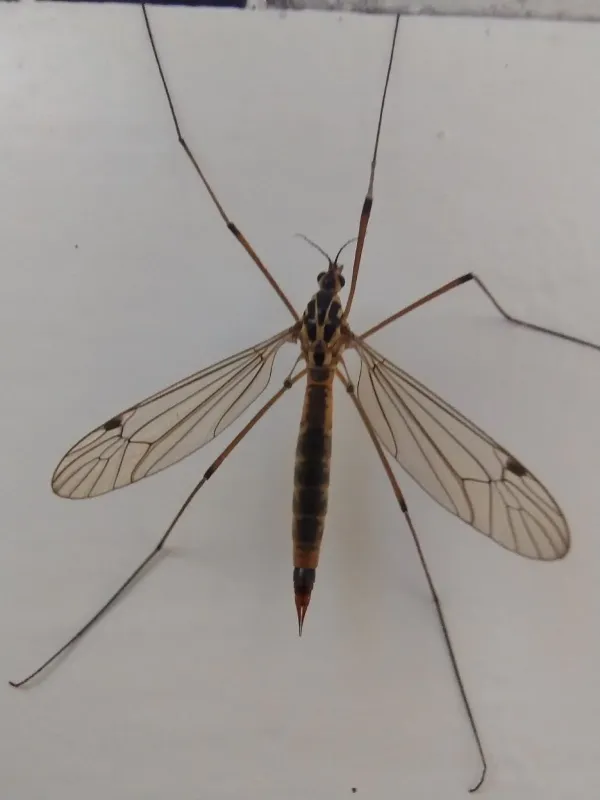
The spotted crane fly (Nephrotoma cornicina) is a dipteran insect belonging to the Tipulidae family. Adult specimens resemble large mosquitoes with long, fragile legs that break off easily upon handling.
The body color of the adult ranges from yellow to brownish, featuring a distinct black pattern on the dorsal side of the thorax and dark stripes along the abdomen. The wings are transparent with clear venation and a yellowish tint along the leading edge.
The larvae, often called leatherjackets, have a cylindrical, slightly tapered shape and are typically gray or brownish. Their skin is tough and leathery, which provides protection against desiccation within the soil environment.
The head of the larva is retracted into the thoracic segments and is barely visible. Full-grown larvae can reach lengths of 30–40 mm, making them significant subterranean residents in the root zone.
The biology of the species is closely linked to moist habitats. Adults are primarily active during twilight hours and prefer shaded areas with dense vegetation for resting and mating.
What it damages
The primary agricultural damage is caused by the larvae living in the upper soil layers. They possess strong mandibles capable of consuming various subterranean parts of plants.
This pest affects a wide range of crops, including cereals such as wheat, barley, and oats, as well as corn and various vegetable crops.
Crops like sugar beets, sunflowers, and perennial grasses are also highly susceptible. Larvae feed on roots, tubers, and the underground portions of stems, often causing the death of young seedlings.
The spotted crane fly poses a major threat during the spring, when seedlings are most vulnerable. High population densities can cause significant thinning of crops, sometimes exceeding 30% loss.
In addition to direct tissue destruction, the feeding sites often become entry points for secondary fungal and bacterial infections, further compromising the health of the crop.
When it appears
The insect follows a univoltine life cycle, completing one generation per year. Adult flight is usually extended, occurring from late spring to mid-summer depending on regional climatic conditions.
Following mating, females lay eggs directly into the soil or onto plant debris, selecting the most humid areas within a field for oviposition.
Larvae hatch after two to three weeks. Initially, they feed on decaying organic matter, but as they grow, they shift their diet toward the living roots of cultivated plants.
Larval activity peaks during autumn and early spring, when they feed intensively before entering dormancy or preparing for pupation.
Pupation takes place within the soil in the spring. The pupa is capable of movement and migrates toward the soil surface prior to adult emergence to facilitate the exit of the fly.
Signs of infestation
The first sign of infestation is the appearance of patchy, thinned, or yellowing seedlings across the field. Affected plants often appear stunted and can be easily pulled from the soil due to root damage.
Inspection of the root system reveals gnawing marks or deep ulcers on the roots. In severe cases, the base of the stem may be completely severed at or just below the soil line.
After heavy rainfall or dew, larvae can sometimes be observed on the soil surface, especially in the early morning. During dry spells, they retreat deep into the soil profile.
The presence of adults is marked by their mass emergence, which often coincides with the flowering period of various weeds found along field edges and windbreaks.
Confirming an infestation is best achieved through soil sampling to a depth of 15–20 cm, a procedure recommended before planting or upon observing the initial signs of crop distress.
Control measures
Effective management of the spotted crane fly relies on cultural practices that create unfavorable conditions for larval development.
- Deep autumn plowing with furrow inversion to expose and kill larvae and pupae.
- Thorough weed management to eliminate alternative food sources and egg-laying sites.
- Optimizing irrigation practices to prevent excessive soil moisture, which favors pest survival.
- Crop rotation to break the life cycle of the pest in heavily infested fields.
Chemical control strategies include the use of insecticide-treated seeds, which provide systemic protection to young seedlings during their most vulnerable growth stages.
In cases of high pest density, soil-applied granular insecticides can be used during planting to establish a protective zone around the seed and developing roots.
Taxonomy
- Latin name
- Nephrotoma cornicina
- Order
- Diptera (flies)
- Family
- Tipulidae
- EPPO code
- PALECO
Discussion
No discussions yet — be the first.