
Ctenophora ornata
Ctenophora ornata
Description
How to identify
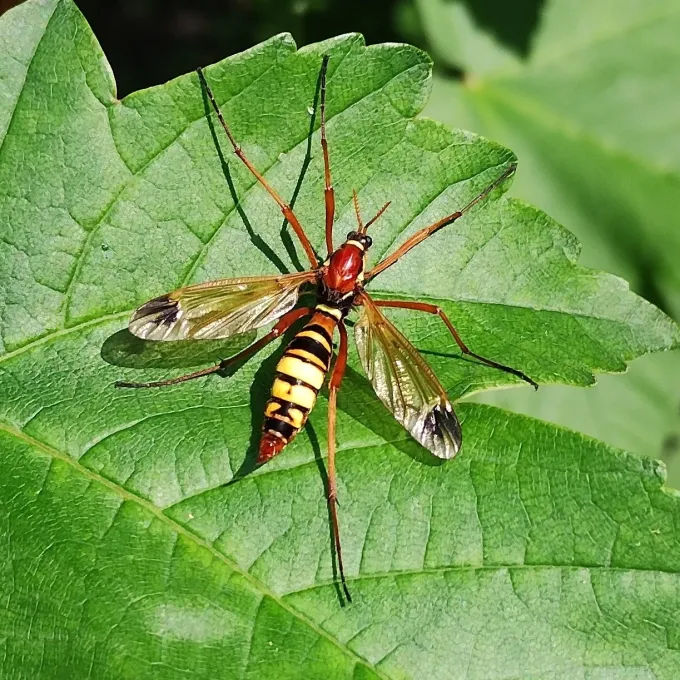
Ctenophora ornata is a species of crane fly belonging to the family Tipulidae, order Diptera. These insects are well-known for their striking mimicry, as their yellow and black coloration resembles that of a wasp.
Adults have long, fragile legs and characteristic wings with a complex network of veins. Males are distinguished by their prominent pectinate (comb-like) antennae, while females possess simple, thread-like antennae.
The life cycle encompasses four distinct stages: egg, larva, pupa, and adult. The adults, commonly known as crane flies, do not feed and dedicate their short lives solely to reproduction.
Larvae have a cylindrical, fleshy body, usually greyish or brownish, with a hardened, sclerotized head capsule. This structure is specifically adapted for boring into decaying wood substrates.
Unlike many other Tipulids that inhabit moist soil, Ctenophora ornata is specifically associated with wood-decay environments in forest or parkland ecosystems.
What it damages
The larval stage is xylophagous, meaning it feeds on decaying wood. These larvae are typically found in the decaying heartwood of older broadleaf trees such as oak, beech, lime, and poplar.
They contribute to the natural decomposition process of dead organic matter in forests. However, in ornamental gardens or managed forests, they may accelerate the decline of weakened trees.
Healthy, vigorous trees are rarely attacked by this species. The presence of larvae is usually an indicator that the tree is already suffering from internal decay or other stress factors.
Ctenophora ornata does not pose a threat to agricultural crops, cereals, or vegetables. Its impact is strictly limited to tree species within forest habitats and old orchards.
Secondary infections, including various wood-rotting fungi, can follow the damage caused by the larvae, further compromising the structural integrity of the affected tree.
When it appears
The flight period for adult Ctenophora ornata typically occurs in late spring and early summer, spanning from May through July. Adults are most active during dusk and twilight hours.
After mating, females oviposit their eggs into cracks in the bark, tree hollows, or directly into decaying wood. This process ensures the offspring have immediate access to a food source upon hatching.
Larvae develop internally within the wood for an extended period, which can last one or several years depending on environmental conditions and the quality of the decaying substrate.
Pupation takes place inside the wood gallery. Just before the emergence of the adult, the pupa often protrudes from the exit hole to facilitate the release of the fly.
Larvae overwinter deep within the wood, which provides a stable thermal microclimate that allows them to survive extreme weather conditions during the cold season.
Signs of infestation
The most visible signs of infestation are the relatively large exit holes on tree trunks, which are left behind when the adult crane fly emerges from its pupal stage.
Accumulations of wood frass (a mixture of excrement and wood particles) found at the base of the trunk or on the bark indicate active feeding by larvae within the wood.
Loose or peeling bark over internal decayed sections can also reveal the presence of tunnels created by the larvae, often accompanied by softened wood textures.
Sap bleeding from fissures in the bark might occur, which further attracts other insects and can contribute to localized discoloration on the trunk surface.
Direct sightings of the distinct, wasp-like adults resting on tree trunks during the early summer months are a reliable indicator of the presence of a local population.
Control measures
The most effective management strategy focuses on maintaining overall tree health. Regular inspection and the removal of dead or dying trees significantly reduce suitable breeding sites.
Sanitation practices, such as clearing away fallen logs, stumps, and large woody debris from the area, help prevent the establishment and mass buildup of the species.
Chemical control is rarely effective against this pest, as the larvae remain deeply embedded within the wood, inaccessible to contact insecticides.
Encouraging natural predators, such as woodpeckers and other insectivorous birds, is a highly recommended biological control method as they actively forage for wood-boring larvae.
- Remove severely diseased or decaying trees to eliminate breeding sites.
- Promote tree vigor through proper irrigation and balanced soil nutrition.
- Install nesting boxes to attract woodpeckers and other avian predators.
Taxonomy
- Latin name
- Ctenophora ornata
- Order
- Diptera (flies)
- Family
- Tipulidae
- EPPO code
- CTPROR
Discussion
No discussions yet — be the first.