

Grape phylloxera
Daktulosphaira vitifoliae
Description
How to identify
Grape phylloxera (Daktulosphaira vitifoliae) is a member of the Phylloxeridae family within the order Hemiptera. It is a tiny, aphid-like insect that represents a major threat to viticulture worldwide.
The insect exists in several forms, including root-dwelling, leaf-dwelling, winged, and sexual forms. The root-dwelling stage is the most destructive and is responsible for the rapid decline of susceptible grapevines.
Its life cycle is complex, involving multiple generations per year. The pest reproduces rapidly, which can lead to severe infestations within a few seasons if not monitored closely.
Phylloxera spreads through nursery stock, soil movement, farming tools, and water runoff, making biosecurity a top priority for grape growers.
It is important to note that this pest is highly host-specific and does not attack other agricultural crops like onions, cabbage, cucumbers, sugar beets, apples, or alfalfa.
What it damages
The primary host of the phylloxera is the grapevine (Vitis vinifera). The insects feed on roots and leaves, causing pathological changes to the plant tissues.
On roots, feeding causes the formation of characteristic swellings known as tuberosities and nodosities. These injuries interrupt nutrient transport and facilitate secondary fungal infections.
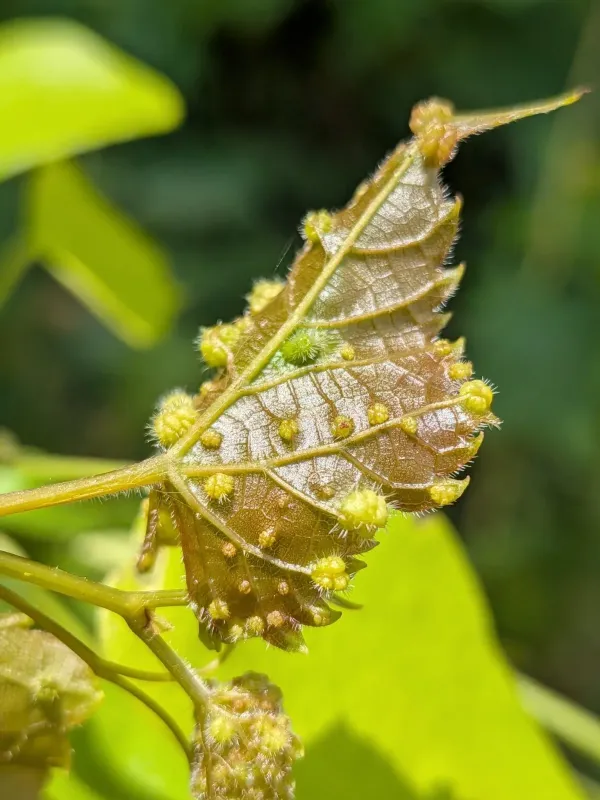
The leaf-dwelling form creates galls on the undersides of leaves, which can reduce photosynthetic capacity and weaken the overall vigor of the vine.
Heavy infestations on roots lead to the gradual death of the root system, eventually causing the entire vine to decline and die over a period of several years.
Unlike generalist pests, phylloxera ignores crops like soybeans or hops, strictly targeting grapevines and making it a specialist threat to the viticulture industry.
When it appears
Activity begins in early spring as soil temperatures rise, usually when they exceed 10-12 degrees Celsius. This triggers the emergence of larvae from their overwintering sites.
During the growing season, the root-dwelling form can produce several generations. Population peaks usually coincide with the period of most vigorous vine growth in mid-summer.
As soil temperatures drop in the autumn, the insects move to deeper soil layers or cracks in the bark to survive the winter conditions until the next spring.
The sexual generation emerges late in the season, producing overwintering eggs that are placed in protected crevices, ensuring the survival of the population.
The speed of development is heavily influenced by soil type; phylloxera thrives in heavy soils while struggling in loose, sandy conditions where root movement is restricted.
Signs of infestation
Initial signs of phylloxera are often subtle, manifesting as a loss of vine vigor, stunted growth, and pale, chlorotic leaves, which can be mistaken for nutrient deficiencies.
Digging up the roots reveals the presence of visible knots or swellings. These deformities are a definitive diagnostic sign of a heavy phylloxera infestation.
Leaf-galling is the most visible sign of the leaf-dwelling form. The undersides of the leaves show small, pouch-like structures where the insects reside and feed.
As the root system decays, the vine begins to collapse. In the final stages, the lack of a functioning root system makes the plant unable to support a crop or new growth.
Professional diagnosis often involves laboratory analysis of root samples to detect the presence of the nymphs, which are otherwise very difficult to see with the naked eye.
Control measures
The primary and most effective method of control is the use of resistant rootstocks. Most modern vineyards use hybrid rootstocks that resist phylloxera feeding.
Strict quarantine measures are essential to prevent the introduction of the pest into clean areas. Always source nursery stock from certified pest-free nurseries.
Chemical control is rarely used for complete eradication because the pests live deep within the soil. Systemic insecticides can provide some temporary suppression.
Hot water treatment (thermotherapy) of dormant vines is a common practice to disinfect nursery stock before planting, effectively killing any attached larvae.
- Utilize phylloxera-resistant rootstocks for all new plantings.
- Implement rigorous vineyard biosecurity and equipment sanitation.
- Conduct regular monitoring and soil sampling for early detection.
In brief
20
Damages crops
Content graph
Damages crops · 20
Content graph
Connections · Grape phylloxera
Most often together:
Marketplace
Products · 12


Komandor
Ф.Меатон Лімітед, Лондон, Великобританія.
Insecticides
0
0
·
2.7K
2 offers
59.51 €per pack
Buy

Nuprid 200
Нуфарм Австралія Лтд. , Австралія (місце виробництва: Чілі
Insecticides
0
0
·
1.9K
6 offers
26.52 €per 1 l
Buy


Zenit w.r.k., (imidacloprid, 200 g/l)
Санрайз Кемікалз Ко. Лтд., Шанхай, Китай
Insecticides
0
0
·
51
1 offer
2.6 €per 1 l
Buy


Komandor
«Юнісіті Ентерпрайсіс Л.П.», Единбург, Великобританія
Insecticides
0
0
·
66
No offers
—
Details

Biology
Taxonomy
- Latin name
- Daktulosphaira vitifoliae
- Order
- Hemiptera (bugs, aphids, leafhoppers)
- Family
- Phylloxeridae
- EPPO code
- VITEVI
Community
Discussion
No discussions yet — be the first.