
Grape phylloxera
Daktulosphaira
Description
How to identify
Grape phylloxera (Daktulosphaira vitifoliae) is a tiny, aphid-like insect belonging to the family Phylloxeridae. It is a highly destructive pest that specifically targets Vitis species.
The insect exhibits a complex polymorphic lifecycle, which includes root-feeding forms, leaf-galling forms, and winged migratory forms, depending on the season and host plant.
Root-dwelling phylloxera are wingless, yellowish, and approximately 1 mm in length. They reside on the roots, where they feed by piercing the tissue with their specialized mouthparts.
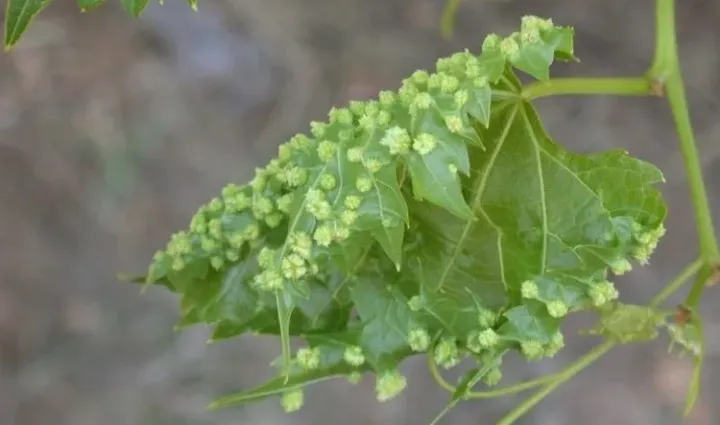
Leaf-dwelling forms create visible galls on the underside of leaves, providing a safe haven for reproduction while causing stress to the canopy of the grape plant.
Winged forms are capable of flight or can be transported by wind, allowing the pest to colonize new vineyard sections effectively over relatively short distances.
What it damages
Grape phylloxera primarily attacks Vitis vinifera, the common European grapevine, which lacks the natural resistance found in certain North American species.
The root-feeding form causes the most severe damage by inducing the formation of root galls, which eventually lead to root decay and the death of fine root hairs.
As the root system becomes compromised, the grapevine struggles to absorb water and nutrients, resulting in reduced vegetative growth and potential vine collapse within several years.
Leaf-galling activity compromises the photosynthetic capability of the vines, weakening the overall plant and reducing the quality and quantity of the fruit yield.
This pest is considered a major quarantine threat, and in many regions, its introduction necessitates immediate destruction of infected vines to save surrounding blocks.
When it appears
Phylloxera activity begins in early spring, typically triggered when soil temperatures warm up sufficiently to stimulate the vine's sap flow.
Throughout the growing season, multiple generations of the pest are produced. The exact number of generations depends heavily on ambient temperatures and regional climate patterns.
Summer is the peak period for migration and colonization, as winged adults move between plants and larvae crawl through soil fissures to reach new healthy roots.
As autumn approaches and temperatures drop, the metabolic activity of the phylloxera slows down, and the insects transition into an overwintering state on the roots.
Understanding these seasonal patterns is crucial for vineyard managers to plan effective monitoring and intervention strategies during the most vulnerable periods for the vines.
Signs of infestation
Detection is often difficult due to the hidden, soil-dwelling nature of the primary infestation, often appearing first as patches of weakened vines in the vineyard.
- Stunted shoot growth and poor vine vigor compared to neighboring rows.
- Chlorosis, where leaves turn yellow or reddish, indicating nutrient stress.
- Visible leaf galls on the underside of young foliage, typically occurring in mid-summer.
- Dieback of roots, which can be confirmed by excavating a small sample of the root system.
In advanced stages of infection, patches of vines may die completely, creating noticeable gaps in the rows that gradually expand over several years if left untreated.
Frequent scouting for leaf galls is a simple but effective early warning system for vineyard managers to identify the arrival of the pest before it established deep in the soil.
Control measures
The most reliable control method is the use of phylloxera-resistant rootstocks for all new vineyard plantings, a practice standard in modern viticulture.
Strict phytosanitary practices are essential, including the rigorous testing of imported nursery stock to prevent the introduction of the pest into clean areas.
Chemical control can be difficult to implement due to the insects' location deep in the soil profile, though systemic insecticides may offer limited short-term suppression.
Planting vineyards in sandy soils remains an effective natural management strategy, as the physical structure of sand prevents the insects from easily moving to find new roots.
Integrated Pest Management (IPM) programs emphasize early detection and rapid removal of infested vines to create a buffer zone and contain the spread of the infestation.
Taxonomy
- Latin name
- Daktulosphaira
- Order
- Hemiptera (bugs, aphids, leafhoppers)
- Family
- Phylloxeridae
- EPPO code
- DAKTSP
Discussion
No discussions yet — be the first.