

Pest · Coleoptera (beetles) · affects Winter rapeseed, Winter wheat, Fodder beet
Especially harmful
Crucifer flea beetle
Phyllotreta sp.
Description
How to identify
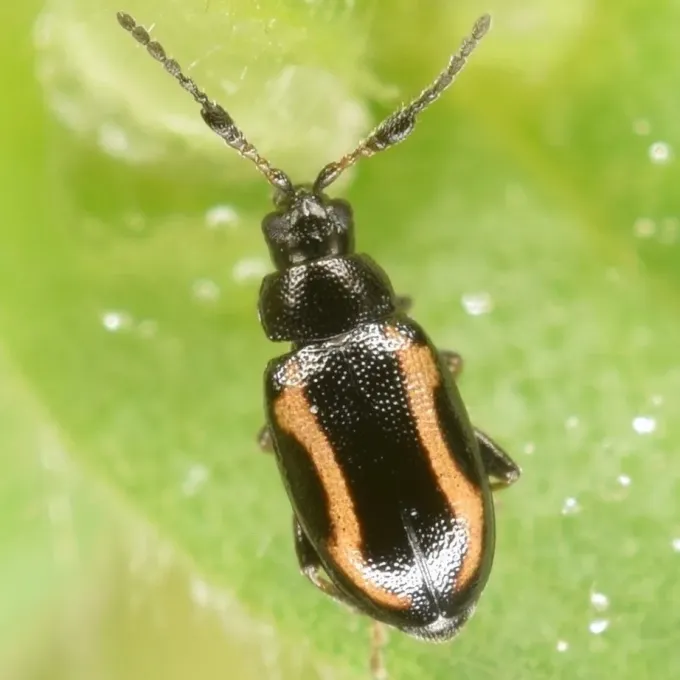
The crucifer flea beetle (Phyllotreta sp.) is a small, jumping beetle belonging to the Chrysomelidae family, known as a major pest of Brassicaceae crops.
Adults are typically 2-4 mm long and often feature a metallic sheen or distinctive light stripes on their elytra, making them identifiable under close inspection.
The name reflects their characteristic jumping habit; they possess enlarged hind legs that allow them to leap away rapidly when disturbed, making them difficult to capture.
They overwinter as adults in the soil or under plant debris, emerging in early spring as temperatures rise to roughly 12-15°C, coinciding with early seedling growth.
The life cycle involves complete metamorphosis, with larvae often feeding on the roots of host plants, while adults focus their feeding on foliage and stems.
What it damages
These beetles feed on a wide range of hosts, including oilseed rape, cabbage, radishes, mustard, and can affect onions, fodder beets, peppers, melons, cucumbers, and strawberries.
The most severe damage occurs on young seedlings, where beetles feed on cotyledons and early leaves, often causing rapid destruction of the plant before it establishes.
Foliage damage appears as small, irregular pits or holes, a condition often called "shot-holing," which can reduce the photosynthetic capacity of the plant significantly.
When infestation is heavy, the entire leaf surface may be consumed, leaving only the veins, which results in stunted growth, wilting, or complete plant mortality.
Even if the plant survives the initial attack, the wounds created by the beetles serve as entry points for various bacterial and fungal pathogens, further weakening the crop.
When it appears
The beetles become active in early spring, precisely when vegetable crops are germinating, posing the greatest threat to emerging seedlings in April and May.
Activity peaks during warm, sunny days when the metabolism of the beetle is at its highest, leading to voracious feeding behavior across the crop field.
The primary period of damage usually persists until the plants develop tougher, mature leaves that are less palatable to the beetles.
A second generation may appear during mid-summer, causing additional pressure on late-season cruciferous vegetables and other susceptible crops in the garden.
As autumn approaches, adult beetles feed on late-season vegetation and weed hosts to accumulate energy reserves before entering hibernation for the winter.
Signs of infestation
The first sign of infestation is the appearance of numerous small, circular holes in the leaves, which often resemble perforations from a fine needle.
Disturbed plants may show symptoms of wilting or slow growth, especially if the beetles have attacked the stem or the growing point of the seedling.
One can easily verify the presence of the beetle by walking through the field; the movement of foliage usually triggers a visible "popping" or jumping of the insects.
In cases of high population density, leaves may show significant chlorosis or browning around the damaged areas due to the loss of tissue and moisture.
Check the underside of the leaves and the soil surface around the base of the plant, as beetles often hide there during cooler or overcast parts of the day.
Control measures
- Use row covers or netting to provide a physical barrier between the emerging seedlings and the beetles.
- Implement early planting dates or use hardy transplants to ensure the crop grows past the susceptible seedling stage before peak beetle activity.
- Maintain consistent moisture with irrigation, as flea beetles thrive in dry conditions and are discouraged by high humidity and damp foliage.
- Apply professional insecticides if the damage exceeds the economic threshold, focusing on systemic treatments for early-season protection.
- Remove cruciferous weeds from the garden perimeter, as they act as alternative hosts that maintain beetle populations throughout the year.
In brief
27
Damages crops
Content graph
Damages crops · 27
Content graph
Connections · Crucifer flea beetle
Most often together:
Marketplace
Products · 262
All 262
Insecticides, Acaricides 234
Rapeseed 10
Mustard 3
False Flax 3
Sunflower 3
Turnip Rape 2
Sugar Beet 1
Potato 1
Radish 1
Crambe 1
Herbicides, Desiccants 1
Wheat 1


Tabu w.s.c., insecticide for seed treatment
ЗАТ Фірма Август, Росія.,селище Вурнари,
Insecticides
0
0
·
62
1 offer
24.7 €per 1 l
Buy


Mospird VP
«Джангсу Інстітут оф Екомоне Чангжоу, Китай.с»,
Insecticides
0
0
·
60
1 offer
9.06 €per 1 l
Buy

Exirel
«Дюпон Інтернешнл Оперейшнз Сарл», Швейцарія
Insecticides
0
0
·
60
4 offers
120.29 €per 1 l
Buy


KARATE ZEON 050 CS
Сингента Лімітед, Великобританія
Insecticides
0
0
·
56
2 offers
16.46 €per 1 l
Buy


Fury w.e., (zeta-cypermethrin, 100 g/l)
Ф.ФМСі, Джексонвіль,США.
Insecticides
0
0
·
54
1 offer
72 €per 1 l
Buy


Balaor Protect
Hangzhou Ruijiang Chemical Co., Ltd.
Insecticides
0
0
·
53
1 offer
46.43 €per pack
Buy

Lightning k.e.
Тейл Експортс ПВТ Лімітед, Ченнай, Індія
Insecticides
0
0
·
53
7 offers
0.12 €per pack
Buy

ALPHA-AMIPRID R.P.
Ф.Меатон Лімітед, Лондон, Великобританія.
Insecticides
0
0
·
53
2 offers
18.99 €per 1 l
Buy


Espada
ДВА Кемікалс Ко. Лтд., Китай (DVAChemicalsCo.Ltd.),China;
Insecticides
0
0
·
52
1 offer
37.4 €per 1 l
Buy


ASISTENT, WP
Jiangsu Institute of Ecomones Co., Ltd.
Insecticides
0
0
·
52
4 offers
19.94 €per 1 l
Buy


Inspector
«Нанджин Ессенс Файн-Кемікал Ко. Лтд» (Китай)
Insecticides
0
0
·
51
3 offers
168.34 €per 1 l
Buy
Biology
Taxonomy
- Latin name
- Phyllotreta sp.
- Order
- Coleoptera (beetles)
- Family
- Chrysomelidae
- EPPO code
- PHYESP
Community
Discussion
No discussions yet — be the first.