

Pest · Coleoptera (beetles) · affects Fodder beet, Common sunflower, Winter wheat
Dorcadion beetle
Dorcadion
Description
How to identify
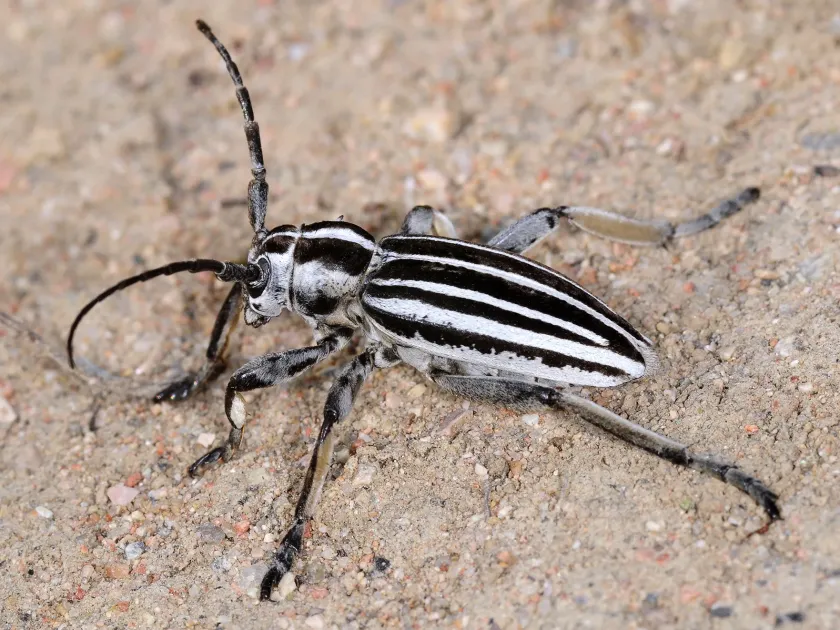
Dorcadion beetles belong to the family Cerambycidae, order Coleoptera. Adult individuals have a dense, robust body measuring 10 to 25 mm, often featuring velvety black or striped coloration.
The larvae of this pest are characterized by a white or yellowish color, a cylindrical body shape slightly thickened at the front, and a well-developed head capsule with powerful mandibles.
Unlike most longhorn beetles that develop in wood, both adults and larvae of the Dorcadion genus lead a strictly terrestrial lifestyle, inhabiting the soil layer.
The identification of adult beetles is complicated by their limited mobility, as they are flightless due to fused elytra and often blend perfectly with the soil color.
The complete development cycle of one generation can take from one to two years depending on regional climatic conditions and soil freezing depth.
What it damages
The main crops at risk are winter and spring cereal grains: wheat, barley, oats, as well as perennial grasses.
Older larvae feed on underground plant parts, chewing through roots and the crown zone, which often leads to the death of young seedlings.
Adult beetles can cause mechanical damage to leaves, but the primary economic damage is caused by the soil-dwelling larvae.
Damage appears in patches, which is linked to the egg-laying habits of females directly into the soil near host plants.
The most significant damage is recorded in steppe regions where the population density of Dorcadion can reach critical levels when crop rotation is neglected.
When it appears
The emergence of adult beetles to the soil surface usually coincides with the start of spring vegetation for cereal crops and the warming of the topsoil layer.
Mass emergence of adults occurs during the tillering stage of cereals, when plants are most vulnerable to subterranean pest attacks.
Egg laying takes place during the spring and summer period, after which first-instar larvae begin active feeding in the rhizosphere.
During summer months, larvae move deeper into the soil, where they spend a significant portion of their development to avoid the drying out of topsoil layers.
Overwintering occurs in the soil at varying depths, with larvae capable of withstanding significant temperature and moisture fluctuations.
Signs of infestation
The first sign of infestation is the sudden thinning of stands and the appearance of bare patches in fields during spring when plants begin to yellow and wither.
Upon inspection of the root system of affected plants, one can clearly see signs of feeding or total severance of the stem base near the crown.
Near affected areas, one can find tunnels made by larvae in the soil, and in the early morning, adults can be seen moving on the soil surface.
The degree of infestation can be easily estimated by conducting soil excavations to identify the presence of larvae in the root zone.
- Yellowing of individual shoots
- Death of the tillering node
- Presence of larvae in the topsoil
- Patchy loss of seedlings
Control measures
An effective agricultural method for control is the strict adherence to crop rotation, avoiding the return of cereal crops to the same field for at least 3–4 years.
Deep autumn plowing with soil inversion facilitates the mechanical destruction of larvae and exposes them to the surface, where they become vulnerable to predators.
Thorough control of weeds, especially grass weeds, deprives the pest of an alternative food source during the off-season.
The use of insecticidal seed treatments allows for the protection of young seedlings during the most vulnerable period of initial root system development.
During periods of mass outbreaks, the use of soil-applied insecticides is justified, but this requires prior economic analysis of pest population density.
Content graph
Connections · Dorcadion beetle
Most often together:
Marketplace
Products · 18


Composite SC, KC
Nanjing No.1 Pesticide Factory of Red Sun Group Co., Ltd.
Fungicides
0
0
·
47
No offers
—
Details
Biology
Taxonomy
- Latin name
- Dorcadion
- Order
- Coleoptera (beetles)
- Family
- Cerambycidae
- EPPO code
- DORDSP
Community
Discussion
No discussions yet — be the first.