

Pest · Coleoptera (beetles) · affects Winter rapeseed, Common sunflower, Winter wheat
Black pine sawyer
Monochamus galloprovincialis
Description
How to identify
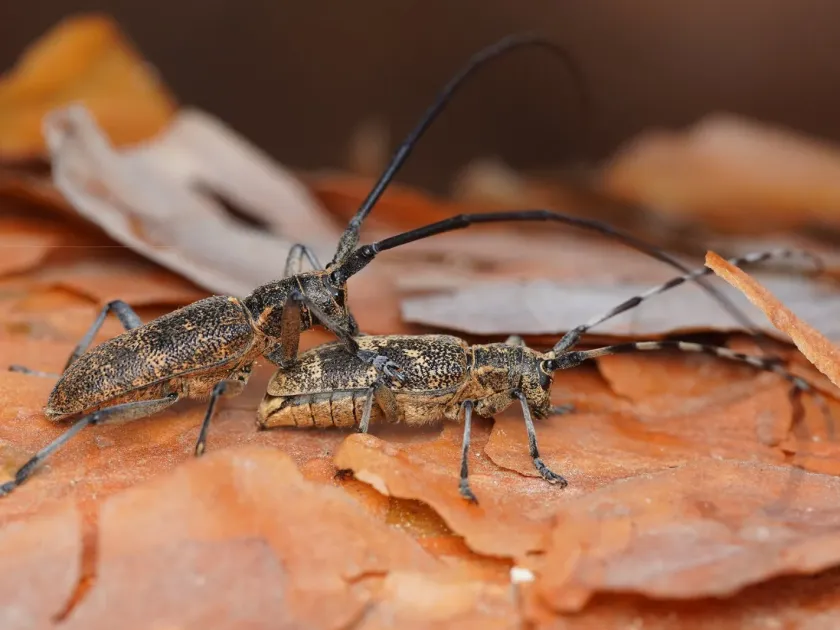
The black pine sawyer (Monochamus galloprovincialis) is a wood-boring beetle belonging to the Cerambycidae family. The adults typically measure between 15 and 30 mm in length and feature a black, somewhat bronzed body covered in fine hairs.
The males are easily distinguished by their extremely long antennae, which can be twice the length of their body. Females have shorter, though still prominent, antennae that slightly exceed the length of their abdomen.
Larvae of this species are legless, whitish grubs with a well-developed, dark-brown head capsule. Their powerful mandibles are adapted for boring through dense pine wood, creating extensive internal networks.
The pupal stage occurs within a specially constructed pupal chamber deep inside the wood. During this transformation, the pupa gradually darkens as it prepares to emerge as an adult.
This beetle is a significant pest due to its role as a vector for the pine wilt nematode, which causes rapid and lethal wilting in many conifer species, making it a critical subject for plant quarantine.
What it damages
This pest primary targets various species of pine, although it can also infest spruce, fir, and larch trees. It is particularly drawn to weakened, stressed, or recently fallen trees that are unable to mount an effective defense.
The primary damage is caused by the larvae, which tunnel through the cambium and eventually bore deep into the heartwood. This activity destroys the tree's vascular system, preventing the transport of water and nutrients.
Timber quality is severely compromised by the galleries carved by the larvae. Once infested, the wood is often rendered useless for construction, significantly impacting the economic value of forest stands.
Adult beetles contribute to the damage by performing "maturation feeding" on the bark of young twigs and needles. While this usually doesn't kill the tree, it leaves wounds that can be entry points for pathogens.
Ultimately, the presence of the black pine sawyer accelerates the death of already struggling forests and serves as a catalyst for the infestation of neighboring, healthy trees by various secondary pests.
When it appears
The adult flight period typically occurs from late spring through late summer, with activity peaking in June and July. During warm, sunny days, the beetles are highly mobile and actively seek suitable host trees.
After mating, the female carves small notches into the tree bark to deposit her eggs. The life cycle usually takes one year, though it can extend to two years in colder climates or less favorable conditions.
Larvae overwinter deep within the wood, which protects them from extreme winter temperatures. As spring arrives, the larvae undergo pupation within their chambers, completing the cycle.
Upon emergence, young adults emerge through circular exit holes. They immediately begin a period of maturation feeding before mating and repeating the life cycle once more.
Seasonal weather patterns significantly dictate the population dynamics. Hot and dry summers are particularly conducive to population booms, often leading to widespread forest health issues in the affected regions.
Signs of infestation
The most visible sign of infestation is the presence of fine, brown "boring dust" (frass) that accumulates near the base of the trunk or caught in the crevices of the tree bark.
One can identify the presence of the sawyer by looking for characteristic egg-laying notches in the bark. These appear as small, often V-shaped or oval wounds made by the female's ovipositor.
Oval-shaped exit holes, approximately 5-8 mm in diameter, are definitive signs that the beetle has successfully completed its life cycle and emerged from the tree.
Wilted needles and the yellowing of the canopy indicate that the tree's vascular health has been severely compromised, often signifying that the infestation is well-established.
Heavy resin flow (resinosis) from the trunk can be observed as the tree attempts to push out the invaders. If the resin flow is excessive, it indicates a strong, yet potentially futile, defense response.
Control measures
Effective management begins with rapid sanitation logging. Removing infested or fallen timber from the forest before the adult beetles emerge is the most crucial step in preventing population outbreaks.
Monitoring using pheromone-baited traps is essential for early detection. These tools help forest managers assess population levels and determine if more aggressive control measures are required.
Proper timber storage is vital. Freshly cut pine logs should never be left in or near forests during the peak flight season, as they act as a "magnet" for the beetles to lay their eggs.
Integrated Pest Management (IPM) techniques, including the promotion of natural predators like woodpeckers and parasitic wasps, can help keep population levels in balance within managed forests.
For international trade and timber movement, strict phytosanitary protocols are mandatory. Heat treatment or chemical fumigation is required to ensure that no live stages of the beetle are transported to new areas.
Reference
Connections · Black pine sawyer
Most often together:
Marketplace
Products · 1
Biology
Taxonomy
- Latin name
- Monochamus galloprovincialis
- Order
- Coleoptera (beetles)
- Family
- Cerambycidae
- EPPO code
- MONCGA
Community
Discussion
No discussions yet — be the first.