
Acalolepta cervina
Acalolepta cervina
Description
How to identify
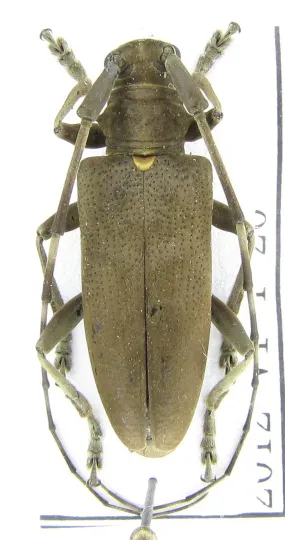
Acalolepta cervina is a member of the Cerambycidae family, commonly known as longhorn beetles. Adults are recognized by their significantly long antennae, often exceeding their body length, and a robust body structure adapted for life on tree surfaces.
The beetle's coloration typically ranges from greyish-brown to yellowish hues, which provides excellent camouflage against tree bark. The surface of the elytra is covered with dense, short hairs, giving the insect a velvety appearance that blends well with its environment.
Larvae are cream-colored or yellowish, featuring a well-developed head and strong mandibles designed for boring through wood. These larvae live almost exclusively within the trunks or branches of host plants, making them difficult to detect during early infestation stages.
The life cycle involves complete metamorphosis, consisting of egg, larva, pupa, and adult stages. The timing of each stage is highly dependent on local environmental conditions and the overall health of the host tree.
As a xylophagous species, the insect plays a specific ecological role but can become a destructive pest when it shifts focus to healthy or commercially valuable trees in orchards or plantations.
What it damages
Damage is primarily caused by larvae that create intricate tunnels deep within the woody tissues of trees. These tunnels sever vascular connections, effectively cutting off the supply of water and essential nutrients from the roots to the canopy.
This pest affects a wide range of broadleaved tree species. Infestations often begin in stressed or dying trees, but high population densities can lead to the successful colonization of healthy, robust trees, leading to widespread decline.
In forestry and arboriculture, Acalolepta cervina is considered a significant threat to timber quality. The internal galleries weaken the structural integrity of the wood, making trees prone to wind damage and snapping.
The accumulation of frass (boring dust) within these tunnels often facilitates the growth of secondary pathogens such as wood-decay fungi, which further accelerate the deterioration of the tree's internal structure.
Typical signs of damage include stunted growth, premature leaf yellowing, and eventually the death of entire branches or the whole tree as the vascular system fails under the continuous boring activity.
When it appears
Adult emergence and activity typically occur during the warmer summer months. During this period, beetles feed on bark and leaves, mate, and females seek suitable sites to lay eggs in crevices of tree bark.
The larval stage is the most prolonged and can persist throughout the year. Larvae overwinter deep within the wood, which provides a thermal buffer against harsh winter conditions, allowing them to remain active during milder weather periods.
Spring marks the period of increased larval feeding activity as sap flow increases in the host trees. This is when boring dust is most commonly observed, as larvae push frass out of their exit holes.
Pupation usually takes place in late spring or early summer within specialized pupal chambers constructed inside the wood. After the transformation is complete, the adult beetle bores a hole to emerge and begin the cycle again.
The generation cycle may take several years to complete, depending on environmental temperature and wood moisture, which makes unpredictable population spikes a characteristic feature of this species.
Signs of infestation
The most reliable sign of an active infestation is the presence of small, oval-shaped exit holes on the surface of the bark. These holes are created by emerging adults and are often clear evidence of a successful life cycle.
Fresh frass, appearing as fine wood sawdust mixed with insect excrement, gathered at the base of the tree or caught in bark crevices, is a clear indicator of active larval tunneling nearby.
In quiet conditions, one may detect faint scraping or gnawing sounds coming from within the trunk or thick branches, which confirms the presence of larger larvae feeding inside the wood.
Canopy thinning and dieback of upper branches in mid-summer, while not unique to this species, often point towards severe internal vascular disruption caused by wood-boring insects.
- Circular or oval holes in bark;
- Accumulations of sawdust (frass) at the tree base;
- Branch dieback or crown thinning;
- Peeling bark exposing tunnel entrances.
Control measures
Sanitation is the most effective management strategy. Regularly inspect trees for signs of infestation and remove heavily damaged individuals to prevent the spread of the beetle to nearby healthy trees.
Pheromone traps can be deployed during the adult flight season to monitor populations and potentially reduce the number of fertile adults available to lay eggs on the host trees.
Chemical control using systemic insecticides applied to the bark or injected into tunnels can be effective for high-value ornamental trees, though it requires precise timing to coincide with adult emergence.
Promoting tree vigor through appropriate fertilization and adequate irrigation is crucial, as healthy trees are better equipped to produce resin or sap that can sometimes deter or drown out young larvae during initial boring attempts.
For valuable specimens, specialized tree injections of insecticides are the preferred method, as they target the pest directly inside the wood without impacting the surrounding environment or beneficial insects.
Taxonomy
- Latin name
- Acalolepta cervina
- Order
- Coleoptera (beetles)
- Family
- Cerambycidae
- EPPO code
- ACLPCE
Discussion
No discussions yet — be the first.