
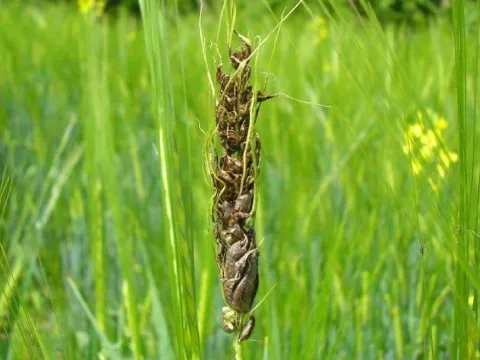
Covered smut of barley
Ustilago hordei
The causal agent of this disease is the fungus Ustilago hordei, which belongs to the kingdom Fungi and the order Ustilaginales. It is a highly specialized plant pathogen.
What the section contains
Covered smut of barley
The pathogen is known as a smut fungus, which relies on the infection of germinating seeds in the soil to complete its biological cycle.
It forms teliospores that persist on the seed surface or in the soil, awaiting favorable conditions for germination and infection of the host.
The fungal mycelium spreads systemically within the plant, moving from the seedling stage through to the development of the barley head.
Taxonomically, it is classified as a basidiomycete that causes significant agricultural damage by replacing grain tissues with masses of spores.
The primary host for Ustilago hordei is barley, although it can occasionally infect other related cereal crops under specific conditions.
The fungus entirely replaces the grain structures within the barley spike, creating a hard, dark, smutty mass encased in a thin membrane.
Infected plants suffer from reduced yield, as no harvestable grain is produced in the affected spikes, directly impacting farm profitability.
During the harvest, these spore-filled structures break, releasing teliospores that contaminate the entire yield and decrease its market value.
Beyond quantity, the quality of the grain is compromised due to the presence of fungal spores, which may render the crop unsuitable for processing.
Infection occurs at the seedling stage, specifically during the period between seed germination and emergence when the plant is most vulnerable.
Favorable conditions for infection include moderate soil moisture and temperatures ranging from 15 to 20 degrees Celsius, facilitating spore germination.
The latent phase of the disease persists throughout the vegetative growth of the barley, with the fungus developing internally alongside the host stem.
Symptoms become visible only during the heading phase, as the fungus shifts its metabolic activity to reproduce within the barley spike.
Spore dispersal occurs during the harvest period, ensuring that the pathogen is carried over to the next season via contaminated seeds.
The most distinctive sign is the replacement of the grains in the barley head by hard, dark masses of spores, remaining protected by a membrane.
Unlike loose smut, the membrane of the covered smut prevents the spores from dispersing immediately, keeping the smutted spike intact until maturity.
Infected spikes appear distorted and often remain partially enclosed by the sheath of the flag leaf, showing a lack of normal grain development.
Upon breaking the membrane, a powdery, black mass of teliospores is released, which creates a noticeable contrast to healthy grain structures.
Typical plant symptoms include:
- Shorter stem development compared to healthy plants.
- Complete replacement of kernels by dark smut sori.
- Delayed maturity phases.
- Presence of gray, thin membranes on the spikes.
Using high-quality, disease-free certified seeds is the primary and most essential step in managing covered smut in barley crops.
Seed treatment with systemic fungicides before planting is highly effective, as it eliminates spores on the seed surface and protects the young seedling.
Adhering to recommended sowing dates ensures that the crop emerges rapidly, reducing the time the seedling is susceptible to soil-borne infection.
Sanitation practices, such as cleaning harvesting equipment, are crucial to prevent the spread of spores from infected fields to healthy grain batches.
Integrating crop rotation and planting resistant barley varieties significantly reduces the pathogen pressure over time, ensuring sustainable production.