
Cowpea mosaic
Cowpea mosaic
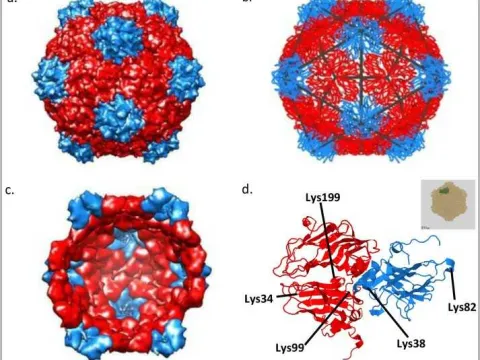
Cowpea mosaic is caused by the Cowpea mosaic virus (CPMV), a member of the genus Comovirus within the Secoviridae family. This plant pathogen is characterized by its icosahedral structure and a bipartite RNA genome.
What the section contains
Cowpea mosaic
As an obligate parasite, the virus relies entirely on the host plant's cellular machinery to replicate. The protein capsid provides stability, allowing the virus to persist in various environmental conditions.
Laboratory techniques such as ELISA (Enzyme-Linked Immunosorbent Assay) or RT-PCR (Reverse Transcription Polymerase Chain Reaction) are essential for accurate identification, as symptoms often mimic nutrient deficiencies.
Transmission occurs primarily through insect vectors, specifically leaf beetles (family Chrysomelidae), which carry the virus during their feeding activity. Mechanical transmission via tools and handling is also possible.
Once inside, the virus moves systemically throughout the plant via the phloem. It invades developing tissues, including leaves, stems, and seeds, ensuring its persistence throughout the host's life cycle.
The virus primarily affects cowpea (Vigna unguiculata) but can also infect a variety of other legume species. Economic damage is most severe when plants are infected early in their growth stage.
Viral infection leads to stunted plant growth, significant yield reduction, and poor seed quality. In severe cases, the crop may suffer complete failure due to the disruption of physiological processes.
Plants weakened by the virus become highly susceptible to secondary pathogens, such as fungal rots and bacteria. This complex interaction often leads to premature death of the entire crop stand.
Reduced photosynthetic capacity is a hallmark of the damage. The distortion of leaf tissue prevents the plant from generating sufficient energy for seed development, resulting in small and malformed pods.
Impact on seed viability is a significant concern for seed producers. Infected seeds act as primary sources of inoculum for subsequent seasons, perpetuating the disease cycle in the field.
The incidence of Cowpea mosaic is strongly linked to the population dynamics of its insect vectors. Warm, humid weather conditions generally promote the activity and dispersal of these vectors.
The incubation period for the virus is typically between one and two weeks. This timeframe varies based on ambient temperatures and the developmental stage of the host plant at the time of infection.
Outbreaks often begin in patches where infected seeds were planted or where initial vector colonization occurred. As the season progresses, vectors spread the virus to healthy plants in adjacent areas.
Symptoms are most prominent during the reproductive phase, specifically during flowering and pod-filling. The high metabolic demand during these stages makes the plant's health decline rapidly.
As temperatures cool toward the end of the season, the rate of new infection might decrease. However, the virus remains present in plant debris, serving as a reservoir until the following year.
The most characteristic sign is a distinct mosaic pattern on leaves, alternating between shades of light green, yellow, and dark green. This pattern may appear as patches or fine mottling.
Leaf distortion is a common symptom, often manifesting as puckering, curling, or inward rolling of the leaf margins. This structural change significantly reduces the plant's leaf area.
- General stunting and reduced biomass of the plant.
- Shortened internodes, giving the plant a bushy appearance.
- Chlorotic spots or mosaic patterns on new, developing leaves.
- Premature dropping of flowers and young pods.
- Deformed, bumpy pods with irregular seed formation.
Severe infections can lead to tissue necrosis, particularly on older leaves. This accelerates the senescence of the plant and leads to premature yellowing and eventual wilting.
Differentiating these symptoms from aphid damage or micronutrient deficiencies is critical. Unlike nutritional issues, viral mosaic patterns are usually accompanied by distinct leaf deformities.
The primary control strategy involves using high-quality, virus-free certified seeds. This prevents the initial entry of the virus into the production field.
Effective management of insect vectors is crucial. Targeted application of systemic insecticides during the early vegetative growth stages can significantly reduce the spread of the virus.
Cultural practices, including the removal of reservoir weeds and maintaining spatial isolation from other legume crops, are essential for reducing infection pressure in the field.
Implementing strict crop rotation schedules helps break the infection cycle. Avoiding legumes in the same plot for several consecutive years prevents the accumulation of the virus and its vectors.
Breeding and utilizing resistant cultivars is the most sustainable approach for long-term control. Resistant varieties remain the most efficient way to maintain yield stability against viral pressure.