
Carnation rust
Uromyces dianthi
Carnation rust is a fungal disease caused by Uromyces dianthi, a member of the Pucciniomycetes class. It is a highly specialized pathogen that exclusively affects plants of the Caryophyllaceae family.
What the section contains
Carnation rust
The fungus is a microcyclic or autoecious parasite, meaning its entire lifecycle, including the production of urediniospores and teliospores, is completed on a single host plant species.
The pathogen overwinters as mycelium within infected plant tissues or as urediniospores in mild climates. In greenhouse settings, infected mother plants serve as the primary source of recurring infection.
Spores are disseminated by air currents, water splashes from irrigation, or through human handling. The fungus enters the plant through stomata, forming pustules that erupt through the epidermis as the mycelium matures.
Development is highly dependent on environmental conditions. High humidity and temperatures ranging from 15°C to 22°C are optimal for spore germination and rapid spread of the disease.
The primary host is Dianthus caryophyllus. The disease affects all aerial parts of the plant, including leaves, stems, and bracts, causing significant physiological distress.
The infection disrupts the host's metabolic functions, leading to chlorosis and stunted growth. As the fungus consumes nutrients from the plant, the plant loses its vitality and aesthetic appeal.
In severe cases, the structural integrity of the stems is compromised. The disease causes premature wilting and drying of foliage, which can eventually lead to the death of the entire plant.
Floral development is also severely impacted. Infected plants often produce malformed, small, or weak buds that fail to open, rendering the crop unmarketable for professional floriculture.
The economic impact is high because the disease is easily transmitted via cuttings. Infested stock plants can cause widespread failure across entire batches of propagation material.
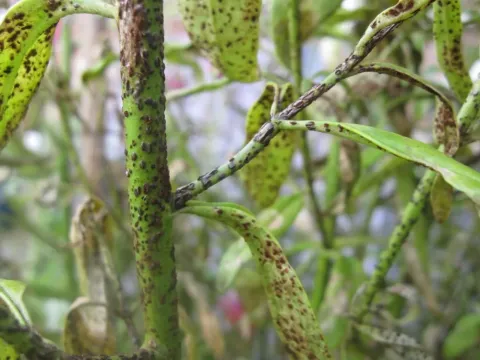
The initial signs include the appearance of small, light-colored flecks on the leaves and stems, which gradually develop into characteristic powdery, rust-colored pustules.
These pustules eventually rupture the epidermis, releasing mass quantities of urediniospores. This rust-colored dust is easily observed when brushing against infected foliage.
Surrounding the pustules, the leaf tissue turns chlorotic, and as the infection progresses, the leaves wither and drop prematurely. The plant takes on a scorched appearance.
On stems, the pustules often develop in linear patterns. This disrupts the stem's vascular system, causing curling, distortion, and increased vulnerability to other opportunistic pathogens.
- Appearance of powdery, rust-colored pustules.
- Yellowing (chlorosis) and drying of foliage.
- Distortion and curling of stems.
- Reduced flower quality and bud development.
Management starts with sanitation. Growers must use disease-free cuttings and implement rigorous inspection protocols for all incoming plant material to prevent the introduction of the fungus.
Cultural control includes maintaining low humidity levels and ensuring excellent air circulation. Proper spacing of plants prevents the microclimatic conditions that favor fungal development.
Avoid overhead irrigation at all costs. Since spore germination requires free water on the leaf surface, sub-irrigation or drip systems are preferred to keep foliage dry.
If the disease is detected, prompt removal and destruction of infected plant parts are necessary. Tools used for pruning must be disinfected after each plant to avoid spreading the spores.
Chemical control involves the application of registered fungicides, such as triazoles or strobilurins. It is critical to rotate active ingredients to prevent the development of resistant strains of the fungus.