
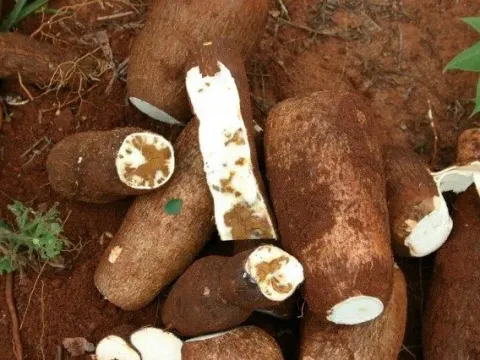
Cassava
Cassava common
Cassava (Manihot esculenta) is a vital staple crop that frequently encounters various plant pathogens. While cassava itself is the host, it is susceptible to significant diseases, most notably Cassava Mosaic Disease (CMD) and Cassava Bacterial Blight (CBB).
What the section contains
Cassava
In terms of taxonomy, cassava belongs to the Euphorbiaceae family. The pathogens that affect it range from viral agents, such as Geminiviruses, to bacteria like Xanthomonas axonopodis pv. manihotis, which pose a constant threat to global production.
Identification involves analyzing clinical symptoms and, in many cases, diagnostic molecular testing. Distinguishing between viral, bacterial, and fungal infections is crucial for implementing the correct management strategy in agricultural settings.
Many of these pathogens are disseminated through infected cuttings or via insect vectors, particularly the whitefly (Bemisia tabaci). Understanding the biology of these vectors is essential for successful disease management.
Regular agronomic monitoring is necessary to track the health of cassava fields. Early detection of suspicious symptoms allows for containment measures, preventing the spread of pathogens across entire plantations.
The damage caused by cassava pathogens significantly impacts root starch accumulation and biomass. Bacterial blight, for instance, affects the vascular system, restricting the movement of nutrients and leading to plant wilting.
Viral infections cause systemic damage, leading to reduced leaf area and photosynthetic capacity. This directly reduces the size and quality of the starchy tubers, which are the main harvestable part of the crop.
Stem necrosis and secondary infections can occur due to weakened immunity, leading to plant collapse and reduced yield. In severe cases, the entire root system may become unsuitable for processing or human consumption.
Economic impact is profound in developing regions where cassava is the primary caloric source. Unchecked disease outbreaks can lead to complete yield failure, threatening the economic stability of smallholder farmers.
Reduced crop quality also impacts the downstream processing sector, as starch extraction efficiency drops significantly when roots are affected by pathogens and subsequent decay.
Disease dynamics in cassava are closely tied to environmental conditions, particularly rainfall and temperature. High humidity levels during the rainy season facilitate the rapid spread of bacterial pathogens and fungal spores.
Temperature fluctuations influence the lifecycle of pathogens. Warm, tropical conditions provide the optimal range for rapid multiplication, often leading to explosive disease outbreaks if monitoring is not consistent.
Insect vector activity is often highest during dry spells, which correlates with the transmission periods of viral diseases. Agricultural planning must account for these seasonal variations to apply preventive treatments effectively.
After the harvest, pathogens often persist in soil debris. Therefore, field sanitation immediately following the harvesting season is a critical preventive measure to reduce the initial inoculum for the next crop cycle.
Predictive models based on weather forecasts are becoming essential for modern cassava management. By monitoring precipitation and temperature, agronomists can predict high-risk periods for disease outbreaks.
Recognizing the signs of cassava infection requires careful observation. Symptoms vary by pathogen but often involve visible changes in leaf morphology and vascular health of the plant.
- Chlorotic mosaic patterns on young leaves (viral).
- Water-soaked spots on leaf blades that turn necrotic (bacterial).
- Exudation of sticky droplets on infected stems.
- Dark, vascular browning visible when the stem or root is cut.
- Overall stunting and leaf distortion.
A visual assessment of the plantation's canopy is a standard practice. Any plant showing characteristic yellowing or curling of the leaves should be isolated or removed to prevent it from acting as a reservoir for viruses.
For bacterial blight, the presence of angular spots and blight on leaves is a key indicator. During high humidity, these spots may spread rapidly, leading to complete leaf loss if not addressed.
Professional diagnostic kits are available for field use, allowing farmers to confirm the presence of specific pathogens quickly and take decisive action to contain the infection.
The primary control measure is the use of healthy, virus-indexed planting material. Sourcing cuttings from certified nurseries is the most effective way to ensure a clean start for the new planting season.
Integrated pest management (IPM) is essential for controlling insect vectors. Applying systemic insecticides to control whitefly populations can significantly reduce the incidence of viral transmissions in vulnerable fields.
Crop rotation and field sanitation play a vital role in reducing pathogen load. Moving cassava to fields that have not hosted the crop recently helps break the cycle of persistent soil-borne pathogens.
Biological control, including the use of beneficial microorganisms and natural antagonists, is gaining traction. These methods offer a sustainable way to suppress pathogen populations while maintaining soil health.
Genetic resistance is the ultimate goal for long-term control. Breeding programs focusing on resistant varieties provide farmers with plants that can withstand local strains of pathogens, ensuring more reliable food security.