
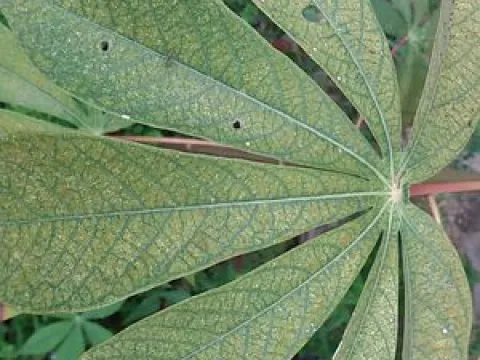
Cassava green mite
Cassava green
The cassava green mite, scientifically identified as Mononychellus tanajoa, is a significant member of the Tetranychidae family. These tiny arthropods are specialized pests that thrive on cassava plants.
What the section contains
Cassava green mite
Adult mites are microscopic, measuring roughly 0.5 mm in length. Their bodies are typically greenish-yellow, providing effective camouflage against the green leaves of their host plants.
Their life cycle consists of egg, larva, two nymphal stages, and adult. Under favorable conditions, particularly high temperatures, the life cycle completes rapidly, facilitating exponential population growth.
These mites are predominantly wind-dispersed, which allows them to colonize new fields effectively. Their high reproductive capacity ensures that even small initial populations can explode into widespread infestations.
They lack the dense webbing associated with some other spider mites, often making their presence difficult to detect until significant plant damage has already occurred.
Mononychellus tanajoa exclusively targets cassava (Manihot esculenta). It primarily feeds on the youngest leaves located at the apical growing points of the plant.
Feeding involves piercing the epidermis and sucking out cell contents. This process leads to the destruction of chloroplasts, which severely impairs the plant's ability to photosynthesize effectively.
As the mite population grows, the plants exhibit stunted growth, leaf curling, and eventual shedding. This process creates the characteristic «candle-stick» symptom where stems remain bare of foliage.
The reduction in foliage leads to a drastic decrease in tuberous root yield. In many cases, farmers can experience significant crop losses ranging from 30% to over 80% if left unmanaged.
The weakened state of the plant makes it susceptible to opportunistic fungal and bacterial pathogens, leading to secondary infections that further reduce plant health and yield quality.
The seasonal activity of the cassava green mite is closely linked to rainfall patterns. These mites thrive during dry seasons when the humidity is low and rainfall is minimal.
Rainfall acts as a natural control factor by physically washing mites off the leaves and increasing humidity, which is detrimental to their survival and reproductive rates.
During extended droughts, the metabolic rate of the mite increases due to higher temperatures, while the host plant suffers from water stress, becoming more vulnerable to mite feeding.
Population peaks are typically observed during the middle to late dry season. Monitoring efforts must be intensified during these times to detect infestations early.
The start of the rainy season often leads to a natural decline in mite populations, as environmental conditions become less favorable for their development and dispersal.
Early symptoms include chlorotic spots on the upper leaves. These spots gradually merge, causing the leaves to lose their healthy green color and appear mottled or yellow.
As the infestation progresses, leaves show clear signs of deformation, becoming twisted and undersized. This deformity significantly limits the surface area available for photosynthesis.
The apical buds often show signs of necrosis or drying out. In severe infestations, the top of the plant appears bare as leaves drop off prematurely due to the extensive damage.
Colonies of mites, along with their eggs and cast skins, can be found on the underside of leaves. Using a magnifying lens is necessary to view these tiny organisms clearly.
- Yellowing and chlorosis of terminal leaves.
- Severe curling and deformation of leaf tissues.
- Premature leaf abscission (drop).
- Significant stunting of plant internodes.
Effective control requires an Integrated Pest Management (IPM) approach that emphasizes biological control, resistant varieties, and proper agricultural practices.
Biological control, such as the introduction of predatory mites like Typhlodromalus aripo, has proven highly successful in suppressing populations in many regions.
Cultural practices include planting during the optimal season to ensure the crop has established sufficiently before the onset of the dry season, thereby increasing its resilience.
Chemical intervention should be used sparingly and only when necessary, targeting specific outbreaks to prevent harming beneficial predator populations that manage the mites naturally.
Monitoring fields regularly for early detection is crucial. Furthermore, maintaining soil fertility and plant health helps the cassava crop better withstand mite-induced damage.