
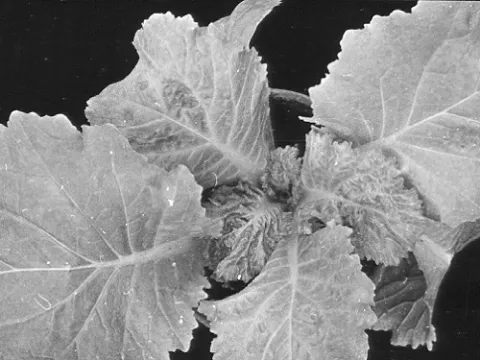
Turnip crinkle virus
Turnip crinkle
Turnip crinkle virus (TCV) is a plant pathogenic virus belonging to the genus Carmovirus within the Tombusviridae family. It is a small, non-enveloped virus with a single-stranded RNA genome that primarily infects cruciferous crops worldwide.
What the section contains
Turnip crinkle virus
As an obligate parasite, the virus replicates within the host cell's cytoplasm, utilizing the plant's metabolic machinery. It is known for being highly stable and can persist in soil, infected plant debris, and even in certain insect vectors for extended periods.
Transmission of TCV occurs through mechanical contact, such as when healthy plants rub against infected ones, or via agricultural tools. Furthermore, it is spread by insect vectors, including flea beetles and several species of aphids that feed on host plants.
A significant aspect of TCV biology is its synergistic interaction with other viruses. For instance, when TCV infects plants alongside Cauliflower mosaic virus, the resulting disease symptoms are significantly more severe than those caused by either virus alone.
The virus is widely distributed globally, often following the distribution of its primary host crops. Its ability to maintain a high titer within host tissues makes it a formidable challenge for plant pathology and agricultural biosecurity.
The primary hosts of TCV include agricultural crops in the Brassicaceae family, such as turnips, oilseed rape, cabbage, radish, and mustard. Various weeds within the same family act as natural reservoirs, allowing the virus to survive between growing seasons.
Infection with TCV leads to reduced vigor, stunted plant growth, and lower overall yields. In commercial crop production, the damage is manifested by smaller, deformed taproots and lower leaf quality, which reduces marketability.
Young seedlings are particularly susceptible to infection. Early-stage outbreaks can cause severe thinning of crop stands, requiring significant investment in reseeding or resulting in permanent yield loss across the field.
The economic impact is particularly pronounced in large-scale oilseed rape production. Because the virus is easily spread by insects, a small initial outbreak can quickly escalate into a widespread epidemic, threatening thousands of acres.
Seed production is also severely affected. TCV-infected plants produce lower-quality seeds with reduced viability, creating a cycle of infection that can be carried over into the next season if farmers use their own saved seeds.
The most characteristic symptom is the curling and distortion of leaves, often accompanied by chlorotic spots or a mosaic pattern on the foliage. The name "crinkle" perfectly describes the puckered appearance of the leaf tissue.
Infected plants exhibit a distinct reduction in height compared to healthy specimens. Internode shortening leads to a stunted, rosette-like growth habit, making the plants appear overly compact and dense, which is a hallmark of TCV infection.
In root crops like turnips and radishes, the virus causes irregular root development. The taproots may become small, woody, or twisted, with a rough exterior, rendering them unmarketable for both fresh consumption and processing.
Symptoms are often more pronounced during periods of fluctuating temperatures and high humidity. While the plant may remain alive, it will consistently show a decline in health and vitality, making it prone to secondary infections.
Because symptoms can easily be confused with nutrient deficiencies or herbicide drift, visual identification is often unreliable. Molecular diagnostic methods like ELISA or RT-PCR are required for definitive confirmation of the presence of TCV.
There are no chemical treatments available to eliminate a viral infection once it has established within a plant. Therefore, control strategies must focus entirely on prevention and reducing the spread of the virus.
Implementing a strict crop rotation schedule is essential. Farmers should avoid planting brassica crops in the same field for at least three to four years to break the pathogen's life cycle and deplete the viral reservoir in the soil.
Effective weed management is critical, as wild cruciferous weeds act as major overwintering hosts. Clearing field margins and irrigation ditches of such weeds reduces the initial inoculum pressure in the spring.
Monitoring and controlling insect vectors is the most important defense. Using targeted insecticides to manage populations of aphids and flea beetles can prevent the rapid transmission of the virus from infected to healthy plants.
Finally, maintaining strict sanitation protocols is necessary. Tools and machinery used in infected fields must be thoroughly cleaned and disinfected before being moved to clean areas to prevent mechanical transmission of the virus particles.