
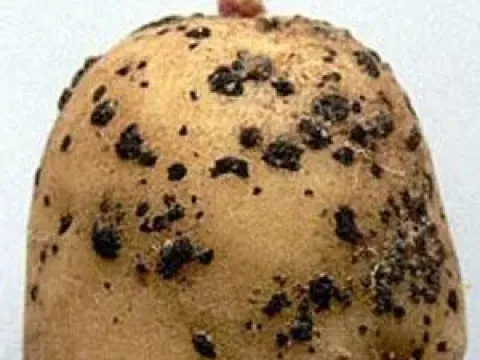
Rhizoctonia
Rhizoctonia
Rhizoctonia is a genus of anamorphic fungi in the order Cantharellales. The most economically significant species is Rhizoctonia solani, which is widely recognized as a primary soil-borne plant pathogen.
What the section contains
Rhizoctonia
Unlike many other fungi, Rhizoctonia does not produce asexual spores (conidia). Instead, it survives and spreads through its hyphae and the formation of sclerotia—hard, dark masses of fungal tissue.
These sclerotia can persist in the soil for several years, waiting for the right environmental conditions to germinate and infect new host plants in the field or greenhouse.
Microscopic identification is based on the characteristic branching of the mycelium, which occurs at right angles, followed by a slight constriction and a septum near the branching point.
The fungus is highly adaptable and can survive as a saprophyte on organic debris in the soil, allowing it to maintain a high population density even in the absence of a susceptible crop.
Rhizoctonia affects a vast array of crops, including potatoes (black scurf), cereal grains (sharp eyespot), and various vegetables like carrots and cabbages, causing significant yield losses.
Damping-off is one of the most common symptoms in young seedlings, where the fungus attacks the hypocotyl, causing the stem to collapse and the seedling to die before it fully emerges.
In mature plants, the pathogen causes severe root rot, which restricts water and nutrient uptake, leading to yellowing of leaves, stunted growth, and eventually plant death during peak production.
In carrots and other taproot crops, the fungus causes crater-like lesions that degrade quality and make the produce susceptible to secondary bacterial rots during storage.
The damage is often compounded by environmental stress, as the pathogen exploits weakened plant defenses to invade vascular tissues and destroy root cortex cells.
The disease is most active during the early stages of plant development, particularly when cool and wet soil conditions slow down the germination and growth of the host plant.
Optimal infection occurs at soil temperatures ranging from 15°C to 25°C, with high soil moisture levels being a critical factor for the rapid spread of mycelia between host roots.
As the season progresses and temperatures rise, the fungus may become less active in causing severe decay, but it begins the cycle of sclerotia formation on the surfaces of underground parts.
Transmission of the fungus primarily occurs through movement of infested soil via machinery, water runoff, or the use of contaminated vegetative planting materials like seed potatoes.
While the pathogen is most visible during the spring, the residual sclerotia in the soil remain a latent threat throughout the entire year, awaiting favorable conditions for the next crop cycle.
The most distinctive signs include brown or black necrotic lesions at the base of the stem (crown), which often encircle the stem and lead to severe plant stunting or breakage.
On potato tubers, dark brown to black sclerotia that look like specks of soil are a key diagnostic symptom; these structures are firmly attached and cannot be washed off.
Under humid conditions, a sparse, web-like white mycelial growth may appear on the lower stem surface, signaling an active and expanding fungal infection.
Seedlings often exhibit "damping-off" symptoms, where they fall over in patches within the field, creating visible gaps in the stand density.
- Patchy crop emergence (stand loss).
- Sunken lesions on roots and stems.
- Black sclerotial bodies on tubers.
- Wilting during sunny, high-transpiration hours.
- Reduced root system volume and brown discoloration.
Crop rotation is the first line of defense; avoiding host crops for at least 3 years can significantly reduce the concentration of Rhizoctonia sclerotia in the topsoil.
The use of high-quality, disease-free seed is crucial, as the fungus is frequently introduced into fields via infested planting material like tubers or infected transplants.
Chemical control focuses on seed and tuber treatment using specialized fungicides, such as fludioxonil or carboxamides, to create a protective zone around the young plant.
Cultural practices such as improving soil drainage, ensuring adequate seedbed preparation, and avoiding excessively deep planting can help plants bypass the most susceptible growth stages.
Biological control agents, particularly Trichoderma species, are increasingly used to colonize the root zone and antagonize the pathogen, effectively inhibiting its growth and virulence.