
Rhabdocline needle cast
Rhabdocline pseudotsugae
Rhabdocline pseudotsugae is an ascomycete fungus that acts as the causal agent of needle cast disease, specifically targeting Douglas fir (Pseudotsuga menziesii).
What the section contains
Rhabdocline needle cast
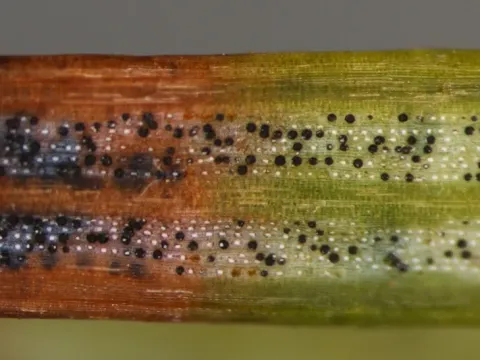
The fungus develops internally within the needle tissues. During the spring, it produces characteristic fruiting bodies called apothecia, which erupt through the needle epidermis.
Its life cycle relies on the dispersal of ascospores, which are released during wet weather in spring and early summer. These spores infect the newly emerging needles of the current season.
The pathogen thrives in cool, moist environments, making nursery conditions particularly conducive to rapid spread and infection cycles.
Microscopic examination of the spores and the morphological characteristics of the apothecia is essential for precise diagnostic confirmation in a laboratory setting.
The primary impact of the fungus is on young Douglas fir trees, particularly in nurseries where high plant density facilitates the rapid transmission of the disease.
Severe infection leads to premature needle shed, which significantly reduces the tree's photosynthetic capacity and hinders its growth rates over time.
In plantation settings, the disease causes aesthetic degradation and potential long-term productivity losses, especially if the canopy density remains high.
Weakened trees become susceptible to secondary infections and environmental stresses, potentially leading to mortality in severe, untreated cases.
The reduction in needle retention renders the trees commercially unsuitable, particularly for the Christmas tree industry or ornamental plantings.
Initial symptoms are characterized by small chlorotic spots on the needles, which later expand and turn into reddish-brown or dark brown necrotic lesions.
A distinctive feature of the infection is the presence of brownish orange, elongated patches or stripes on the undersides of the needles where the fungus sporulates.
Affected needles usually yellow and fall off prematurely by early summer, leaving the shoots bare and significantly impacting the overall density of the tree crown.
Symptoms are most visible during the spring, coinciding with the maturation of the fungus and the release of ascospores into the surrounding environment.
- Chlorotic spots on young needles.
- Reddish-brown necrotic bands.
- Spore-bearing apothecia erupting through the epidermis.
- Premature needle abscission in late spring.
Sanitation is a critical control measure; removing and destroying infected foliage can significantly reduce the local inoculum load for the following season.
Selecting and planting resistant genotypes of Douglas fir is the most effective long-term strategy for managing the disease in both nurseries and forests.
Fungicide applications are most effective when timed with the period of needle expansion in the spring to protect new growth from ascospore infection.
Improving air circulation through wider spacing and site selection helps to lower humidity levels, which effectively discourages the establishment of the fungus.
Regular monitoring of young plantations during the critical spring months allows for early detection and intervention, preventing large-scale epidemics.