
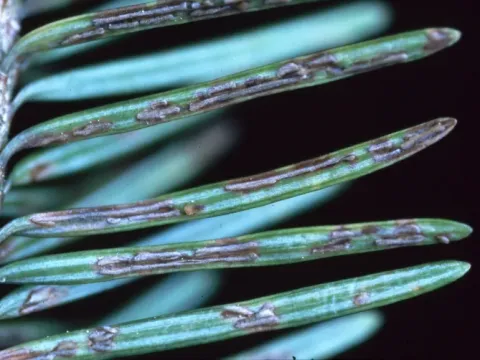
Rhabdocline needle cast
Rhabdocline weirii
Rhabdocline needle cast is a fungal disease caused by Rhabdocline weirii. It is a highly specialized ascomycete pathogen that exclusively affects trees of the Pseudotsuga genus.
What the section contains
Rhabdocline needle cast
The fungus is an obligate parasite that completes its life cycle on the host's needles. Its evolutionary specialization makes it a significant pathogen in environments where Douglas-fir monocultures are grown.
The taxonomy of this pathogen places it within the Ascomycota division. It is adapted to survive in temperate climates, relying on specific moisture windows during the spring season to disperse its spores.
The fungus penetrates the host tissues through the stomata or epidermis of needles. Once inside, it establishes a mycelial network that draws nutrients from the host plant's internal tissues.
Identification often requires careful inspection, as the pathogen's growth remains latent for long periods. Microscopic analysis of apothecia is the most reliable diagnostic tool for this fungus.
The primary host for this pathogen is the Douglas-fir (Pseudotsuga menziesii). Severe infections lead to premature needle abscission, which significantly reduces the tree's health and vigor.
Loss of foliage impairs the tree's ability to conduct photosynthesis, leading to stunted growth. In extreme cases, repeated infections over several years can result in tree mortality.
In nursery settings, the economic impact is substantial. Infected seedlings often become unsellable, and the spread of the disease can force the destruction of entire plant batches.
In natural forests, the disease contributes to the decline of stands. By weakening the trees, Rhabdocline weirii facilitates the secondary attack by bark beetles and other wood-boring insects.
The loss of aesthetic value is a major concern for landscape plantings. The yellowing and dropping of needles make affected trees look sparse and unhealthy, detracting from their ornamental role.
Symptoms initially appear as yellow-to-brown spots on the needles of the previous year's growth. These spots expand over time, causing the needle to transition to a dull, reddish-brown color.
During the spring, the characteristic apothecia (fruiting bodies) emerge on the underside of the needles. They appear as small, elongated, or oval-shaped swellings that split the needle epidermis.
When the spores are ready for release, the epidermis ruptures, revealing the fruiting bodies. This gives the needle a rough, textured appearance with fine longitudinal cracks.
Needle shedding is a prominent sign. By early summer, heavily infected needles fall off, often leaving the lower parts of the tree canopy looking bare and skeletal.
Uneven discoloration of the crown is a common visual indicator. A contrast between healthy new growth and the discolored older needles helps in identifying infected individual trees.
The most effective strategy in nurseries is strict sanitation. All infected needles and plant debris must be collected and destroyed to reduce the inoculum load for the next season.
Fungicide applications are crucial in areas with high disease pressure. Copper-based or systemic fungicides applied during the period of spore release can provide effective protection.
Good cultural management is essential. Ensuring adequate spacing between trees improves air circulation and helps keep the foliage dry, which inhibits the infection process of Rhabdocline.
Monitoring the timing of spore discharge is vital for planning chemical treatments. Spraying during the wet spring months is the most effective approach to protect new, susceptible growth.
The long-term control strategy involves selecting resistant varieties of Douglas-fir. Breeding programs focusing on natural resistance can significantly reduce dependency on intensive chemical management.