
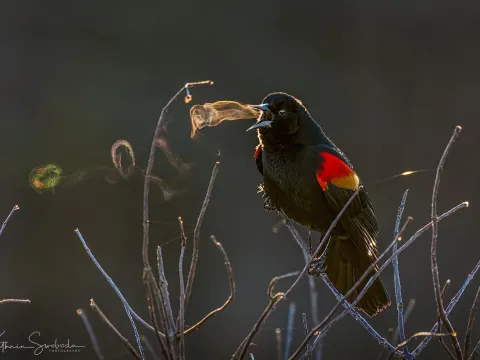
Red-winged blackbird
Red-winged blackbird
The Red-winged blackbird (Agelaius phoeniceus) is a species of the Icteridae family. Within agronomy, it is categorized not as a pathogen, but as a major vertebrate pest affecting various agricultural crops.
What the section contains
Red-winged blackbird
Adult males are easily recognized by their glossy black plumage featuring distinct red shoulder patches with a yellow border. Females exhibit a streaky brown appearance, which serves as camouflage during nesting.
Taxonomically, the species belongs to the order Passeriformes. Their high population density and social structure make them one of the most economically significant avian pests in North America.
These birds are highly adaptive to agricultural landscapes. They thrive in fields, forming massive flocks that can rapidly deplete standing crops if left unmanaged.
The life cycle of the Red-winged blackbird is closely synchronized with agricultural seasons, as they rely heavily on cultivated grains and sunflowers for food during critical stages of their development.
The primary damage occurs during the milk and dough stages of corn development. Birds strip the husks from the ears to feed on the developing kernels, leading to significant yield loss.
Beyond corn, they cause substantial damage to sunflowers, rice, and sorghum. They feed directly on the seeds, reducing both the total quantity and the market quality of the harvest.
Mechanical damage to husks and plant tissues facilitates the entry of fungal pathogens, such as Fusarium species, which lead to secondary ear rots and mycotoxin contamination.
Early in the season, birds frequently pull up emerging seedlings, particularly in corn and other cereal crops, leading to gaps in stands that necessitate costly replanting efforts.
Economic losses arise not only from the direct consumption of seeds but also from the increased susceptibility of damaged crops to environmental stressors and subsequent infections.
The peak period of damage occurs during the mid-to-late summer months when cereal crops and sunflowers reach their most vulnerable stages of maturity.
During the spring, the birds focus on freshly planted fields and emerging seedlings. This early damage can significantly impact plant population density and uniform crop development.
Daily activity cycles involve movement from wetland roosting sites to agricultural fields in the early morning and late evening, making these times critical for observation.
Weather conditions, such as severe droughts, can drive birds to seek moisture in crops, increasing the intensity of the damage during periods of water scarcity.
Autumn migration represents another window of vulnerability for late-maturing crops, as flocks congregate in large numbers before their departure to southern regions.
The presence of these birds is indicated by ragged, torn husks on corn ears and partially or entirely eaten grain rows, often leading to stunted or rotting ears.
In sunflower fields, signs include missing or damaged seeds in the head, often accompanied by bird droppings on the leaves and stalks below the flower head.
- Stripped and shredded corn husks.
- Missing achenes (seeds) in sunflower heads.
- Broken stalks resulting from the weight of large flocks settling on plants.
- Increased presence of secondary fungal growth on damaged plant parts.
Visible ear rot or mold development is a frequent secondary sign of previous bird damage, as the opening of the husk allows moisture and spores to penetrate the grain.
Monitoring the flight patterns and flock behavior allows farmers to identify high-risk areas, as these birds typically exhibit strong site fidelity during the feeding season.
Effective management requires an integrated approach using deterrents. Acoustic dispersal systems, such as distress calls, are useful but require frequent rotation to prevent habituation.
Visual deterrents, including predatory bird silhouettes and reflective streamers, can offer temporary relief if deployed prior to the onset of the damage period.
Agricultural practices, such as planting varieties with tighter husk covers for corn, can significantly reduce the ability of birds to reach the kernels.
Habitat management, including the removal of nearby brush or weed-dense areas that provide roosting sites, can help decrease the local attractiveness of the fields.
Success in crop protection is achieved by combining multiple deterrent methods and maintaining a consistent monitoring program to prevent the formation of large, persistent feeding flocks.