
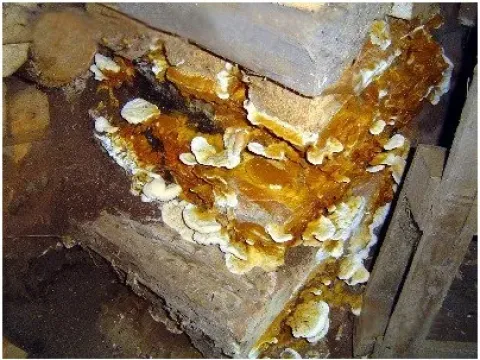
Resinicium bicolor
Resinicium bicolor
Resinicium bicolor is a species of crust fungus within the family Hydnodontaceae, known for its role as a wood-decay agent in forest ecosystems.
What the section contains
Resinicium bicolor
The fungus typically forms resupinate (crust-like) fruiting bodies that spread closely over the surface of decaying wood, often displaying a creamy or yellowish hue.
Under microscopic analysis, the fungus is characterized by its distinct cystidia, which are often heavily encrusted, serving as a key identification feature for mycologists.
While it functions primarily as a saprotroph breaking down dead wood, it can act as a secondary pathogen, invading stressed or weakened coniferous trees.
The species is widely distributed throughout temperate regions, commonly appearing on various conifer species including spruce and fir.
Resinicium bicolor causes white rot in the timber of infected trees, leading to the breakdown of both lignin and cellulose within the woody tissue.
This infection severely compromises the structural integrity of the tree, significantly reducing the commercial value of the wood for forestry purposes.
In forest stands, the fungus often targets the root system and the lower trunk, predisposing the affected trees to windthrow and mechanical failure.
As the fungus degrades the inner wood, the structural weakness becomes progressive, often going unnoticed until the tree shows visible symptoms of decline.
The cumulative damage caused by this pathogen can lead to significant economic losses in managed forests due to the mortality of infected timber.
The fungus is most active during the warmer months, typically from late spring to autumn, when environmental conditions favor its growth.
Basidiospore production and dispersal are highly dependent on humidity, peaking during periods of high rainfall and moderate temperatures.
Although growth rates decline during the winter, the mycelium remains active within the protected environment of the woody substrate.
Optimal development typically occurs between 15°C and 25°C, provided that the internal moisture content of the infected wood remains sufficient.
Spread by airborne spores allows the pathogen to colonize new sites rapidly whenever favorable moisture and temperature conditions align.
Visible signs of infection include the development of thin, spreading crusts on the bark or wood surfaces near the base of the trunk or on stumps.
Internal wood decay exhibits a pale or whitish bleached appearance, often accompanied by a loss of mechanical hardness and a fibrous, stringy texture.
In advanced stages, the internal structure of the tree shows significant degradation, often resulting in cavities filled with mycelial mats.
Foliar symptoms may include thinning of the canopy and a gradual change in needle color as the tree's vascular health declines due to root or stem decay.
- Spreading creamy/yellowish crusts on the bark.
- Fibrous white rot texture in the heartwood.
- Increased tree instability and risk of windthrow.
- Reduced crown density and discolored needles.
Sanitation is the primary control method, involving the identification and removal of infected trees to reduce the overall spore load in the forest.
Preventing mechanical damage to the trunk and root collar during logging operations is essential, as these wounds provide entry points for the fungus.
Biological control, such as treating fresh stumps with antagonist fungi (e.g., Phlebiopsis gigantea), can successfully inhibit colonization by the pathogen.
Forest management strategies should focus on maintaining stand health and vigor to improve the tree's natural defense against secondary infections.
Early detection through regular field surveys and the use of diagnostic tools can prevent small outbreaks from spreading into larger forest areas.