
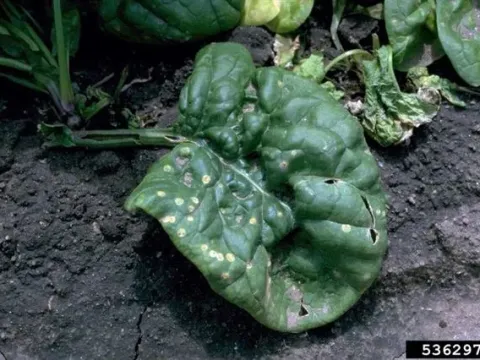
Spinach Ramularia
Ramularia spinaciae
Spinach ramularia is a fungal disease caused by the pathogen Ramularia spinaciae. It is a member of the kingdom Fungi and the order Capnodiales, known for causing significant leaf spot infections.
What the section contains
Spinach Ramularia
The pathogen primarily survives in soil and on infected plant debris, persisting through winter as mycelium or conidia. It is highly host-specific, targeting members of the Amaranthaceae family, particularly spinach.
The life cycle is driven by the production of conidia, which are disseminated by wind, water splashes, and physical contact. The fungus requires high humidity and moderate temperatures, typically between 18-22 degrees Celsius, to thrive.
Infection occurs when conidia land on healthy leaves and penetrate the tissue through stomata. Once inside, the fungus colonizes the leaf tissues, resulting in the characteristic symptoms of the disease.
The pathogen's ability to remain dormant in crop residues makes it a recurring problem in fields where crop rotation practices are neglected or ignored by farmers.
The primary damage caused by Ramularia spinaciae is the development of leaf spots, which reduce the photosynthetic area of the spinach plant. This leads to stunted growth and lower crop yields.
As the disease progresses, the leaves become discolored and necrotic, making them visually unappealing and unsuitable for commercial sale. In severe cases, entire leaves can die off prematurely.
In greenhouse environments, the infection can spread rapidly, causing significant economic losses by compromising the entire crop's quality and shelf life.
Plants affected at an early developmental stage may fail to produce a marketable rosette of leaves, leading to total loss of the harvest in specific field sections.
The accumulation of spores in the soil over consecutive seasons increases the severity of the outbreak, making subsequent cultivation increasingly difficult and costly.
The initial symptoms are small, pale-green or yellowish spots on the leaves. These spots are often circular or irregular and serve as the first visual indicator of the disease.
Over time, these spots turn greyish or brown and may develop a dark halo. In moist conditions, a characteristic white to greyish mealy growth is visible on the undersides of the leaves within the spot areas.
As the infection intensifies, the spots enlarge and coalesce, eventually covering large portions of the leaf blade, leading to overall wilting and drying of the foliage.
- Pale yellow or green spots on leaf surfaces.
- Greyish mycelial growth on the leaf underside.
- Necrosis and browning of the leaves.
- Premature leaf death and wilting.
Correct identification often requires microscopic examination of the fungal spores to distinguish it from other spinach leaf spot pathogens like Stemphylium or Cercospora.
Effective crop rotation is the cornerstone of managing spinach ramularia. Avoiding planting spinach in the same field for at least 3-4 years helps break the pathogen's life cycle.
Removing and destroying crop residues immediately after harvest is essential to reduce the primary inoculum load for the next planting season.
Improving air circulation within the canopy by maintaining proper plant spacing can significantly reduce the humidity levels that the fungus requires to develop.
Using drip irrigation instead of overhead watering minimizes the spread of spores via water splashes, thereby reducing the risk of rapid disease transmission across the field.
When environmental conditions favor the disease, the application of registered fungicides may be necessary. Always adhere to local regulations regarding pre-harvest intervals for edible crops.