
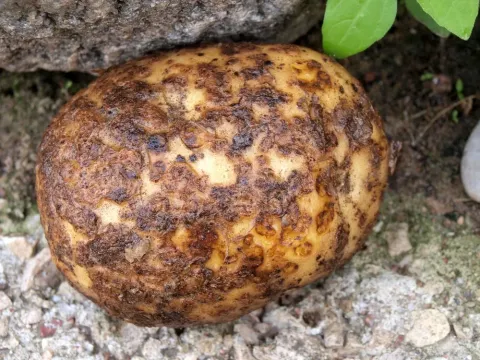
Spongospora subterranea
Spongospora subterranea
Spongospora subterranea belongs to the class Phytomyxea and is an obligate parasite, often classified as a soil-borne protist.
What the section contains
Spongospora subterranea
The pathogen persists in the soil as cystosori—spongy structures containing thousands of resting spores that can remain viable in the field for up to 6–10 years.
This pathogen is also known as the primary vector for the Potato Mop-Top Virus (PMTV), which significantly increases its economic threat to agricultural production.
Systematically, this organism is not a true fungus but rather a slime mold that parasitizes the cells of plant roots and tubers.
For laboratory identification, PCR diagnostic methods are employed, allowing for the detection of spore presence in soil and seed material even at very low concentrations.
The primary host is the potato, where the pathogen causes a specific disease known as powdery scab, as well as the formation of root galls.
In addition to potatoes, Spongospora subterranea can infect a wide range of plants in the Solanaceae family, including tomatoes, peppers, and eggplants.
The pathogen causes severe damage to crop quality: tubers lose their marketability and become unsuitable for long-term storage or processing.
Root galls caused by Spongospora disrupt water and nutrient uptake, leading to general plant stunting and reduced yield potential.
The damage is exacerbated by co-infection with other pathogens, as the damaged tuber tissues become vulnerable to secondary bacterial and fungal rot.
The life cycle begins with the germination of resting spores in soil under conditions of high moisture and moderate temperatures (typically 12–18°C).
Zoospores released from cystosori actively swim through soil water to infect root hairs, tuber epidermis, and stolons of the host plant.
Disease development is most intense during cool and rainy seasons when soil moisture exceeds 70-80% of water-holding capacity.
Secondary infections can occur throughout the growing season if sufficient moisture is available, facilitating the spread of the disease within the field.
In autumn, as new tubers form, the pathogen colonizes their surface, developing new spore masses that serve as the primary inoculum for future years.
Initial symptoms of powdery scab appear on young tubers as small, light-colored pustules that gradually enlarge and darken over time.
- Emergence of small, wart-like blisters on the tuber surface.
- Rupture of the tuber skin revealing "craters" filled with brown, powdery spore masses.
- Characteristic irregular growths on roots known as galls, which are initially pale and turn brown as they age.
- General plant wilting during dry spells caused by severe damage to the root system.
- Dark lesions that may promote secondary soft rot development when exposed to excess water.
The primary control measure is the use of healthy, certified seed tubers that are free from pathogen spores.
Implementing a crop rotation strategy is essential: potatoes should not return to the same field for at least 4–6 years to reduce the soil inoculum level.
Avoiding soil waterlogging is crucial; proper field drainage significantly limits the mobility of zoospores and their ability to infect new plants.
Chemical control includes seed treatment with fungicides, though the efficacy is limited due to the high environmental persistence of the resting spores.
Liming of acidic soils is recommended, as Spongospora subterranea thrives in low pH conditions, while slightly alkaline environments help suppress its activity.