
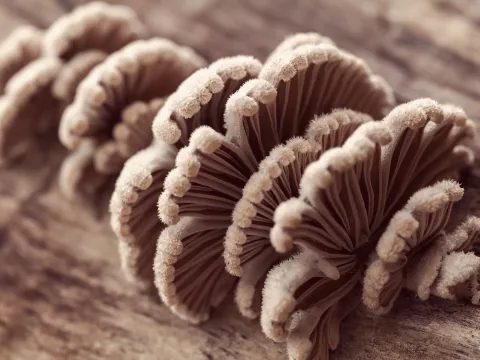
Split gill fungus
Schizophyllum commune
Split gill fungus (Schizophyllum commune) is a basidiomycete fungus belonging to the order Agaricales. While primarily a saprotroph that decomposes dead wood, it is also a facultative parasite capable of infecting stressed or wounded living trees.
What the section contains
Split gill fungus
The fruiting bodies are fan-shaped, typically lacking a stalk, and covered with a whitish-grey hairy layer. The undersurface consists of distinctive split gills that fold shut in dry conditions and reopen during humid weather, a unique feature for which it is named.
Its mycelium is highly effective at penetrating woody tissues through wounds or pruning cuts. Once inside, it decomposes both lignin and cellulose, which are the main structural components of wood.
The life cycle involves the production of basidiospores released from the gills. These spores are dispersed by wind over long distances, germinating quickly when they land on a suitable moist surface, such as an exposed pruning wound.
The fungus is highly resilient to environmental stress, allowing it to survive in dormant states for long periods before re-activating under favorable humidity levels, making it a persistent threat in orchards.
This pathogen affects a wide range of hardwoods, including fruit trees like apple, pear, and plum, as well as various nut trees. In forestry and agriculture, it is often found on trees weakened by drought, frost, or mechanical damage.
It causes white rot, leading to the rapid softening and degradation of the wood structure. As the fungus consumes the heartwood and sapwood, the tree loses structural integrity, eventually resulting in branch failure or total tree death.
Infection often starts at poorly managed pruning sites. If not addressed, the decay spreads inward, colonizing the cambium and xylem, which severely impairs the tree’s ability to transport water and minerals.
The damage is cumulative and often hidden inside the stem. By the time visible fruiting bodies emerge on the bark, the internal colonization may be extensive, leaving little room for remedial action.
Economic damage includes reduced fruit yields, premature senescence of orchards, and the necessity of removing valuable mature trees, which constitutes a significant loss for the grower.
The fruiting bodies are most active from late spring to late autumn. However, the mycelium within the wood can remain physiologically active throughout the year as long as internal temperatures are above freezing.
Spore dispersal is highly dependent on humidity. Rainfall or heavy morning dew triggers the opening of the gills, releasing masses of spores into the air, which maximizes the chances of infecting nearby susceptible plants.
Winter does not typically kill the fungus. It survives within the host tissue, and its growth can resume during mild spells, allowing the pathogen to slowly expand its necrotic zone even during the dormancy of the host.
Early spring is a critical time for monitoring, as pruning wounds are highly susceptible to fresh spore colonization when the weather is warm and damp.
Environmental factors, such as prolonged drought followed by heavy rain, weaken the tree’s natural defenses, making it the most vulnerable period for the fungus to establish a new infection site.
The most obvious sign of an active infection is the appearance of small, fan-shaped mushrooms on the bark or at the site of cracks. They appear in clusters and are usually greyish-white with a fuzzy texture.
The infected bark often shows signs of necrosis, cracking, or localized sunken areas. Peeling back the bark in these areas reveals dense white mycelial threads that resemble felt or mats of white fiber.
The wood beneath the bark becomes soft, spongy, and brittle. A telltale sign is the ease with which a knife or probe can penetrate the affected wood compared to healthy tissue.
General tree decline is another symptom: leaves may turn yellow or drop prematurely, and certain branches may show signs of dieback despite no evidence of common insect pests.
Internal decay often creates cavities or hollows, which provide a protected microclimate for the fungus to fruit, further increasing the spore load in the immediate environment of the orchard.
Sanitation is the cornerstone of control. All infected branches must be pruned away well into the healthy wood and immediately burned or removed from the site, as the fungus continues to release spores even on detached wood.
All pruning wounds larger than a few centimeters should be sealed with a fungicide-enriched wound dressing to prevent spores from germinating on the exposed tissue.
Maintaining tree vigor through proper fertilization, irrigation, and soil management is essential. A healthy tree can compartmentalize infections, creating chemical barriers to stop the fungus from spreading.
Disinfecting pruning tools between trees using ethanol or bleach is mandatory to prevent the mechanical transmission of mycelial fragments or spores from infected to healthy trees.
- Regular whitewashing of trunks with fungicide-treated lime.
- Prompt cleaning and filling of cavities to prevent moisture accumulation.
- Removal of old stumps that act as long-term spore reservoirs.
- Selecting tree varieties adapted to the local climate to minimize environmental stress.