
Stem rust
Puccinia graminis
Stem rust is caused by the basidiomycete fungus Puccinia graminis, a highly specialized pathogen that requires different hosts to complete its complex life cycle.
What the section contains
Stem rust
The fungus is heteroecious, meaning it alternates between a primary cereal host (such as wheat or barley) and an alternate host, typically common barberry (Berberis vulgaris).
Inside the host plant, the fungus develops an intercellular mycelium that extracts nutrients using specialized structures called haustoria, which penetrate host cell walls.
The pathogen is notable for its high genetic diversity, manifesting in numerous physiological races that can overcome the resistance genes of many commercial crop varieties.
Dissemination is primarily achieved through urediniospores, which can be carried by wind currents over hundreds of kilometers, potentially leading to regional outbreaks.
This pathogen targets stems and leaf sheaths of essential cereal crops, including wheat, rye, and barley, severely impacting their physiological functions.
By disrupting the host's vascular system and epidermis, the fungus causes excessive water loss and restricts the movement of nutrients to the grain, resulting in significant yield reduction.
In severe cases, stem rust causes lodging, as the weakened stems lose structural integrity and collapse under the weight of the developing ear.
The quality of the harvested grain is drastically reduced, appearing shriveled and having lower test weights, which affects both nutritional value and marketability.
Stem rust remains one of the most destructive diseases in global agriculture, capable of destroying entire fields in favorable environmental conditions.
Disease development typically peaks during the mid-to-late growth stages, specifically from the jointing to the grain-filling phases of cereal development.
Optimal conditions for infection include warm temperatures (ranging from 15°C to 25°C) combined with high humidity, such as dew or light rain, which provide the necessary free moisture.
During the summer, the fungus produces repeated cycles of urediniospores, allowing for rapid secondary infections and the exponential growth of the disease within the crop.
As the plant reaches maturity or environmental conditions become drier, the fungus transitions to producing teliospores, which are survival structures for overwintering.
The severity of an epidemic is closely tied to seasonal weather patterns; wet, warm seasons significantly increase the risk of rapid pathogen proliferation.
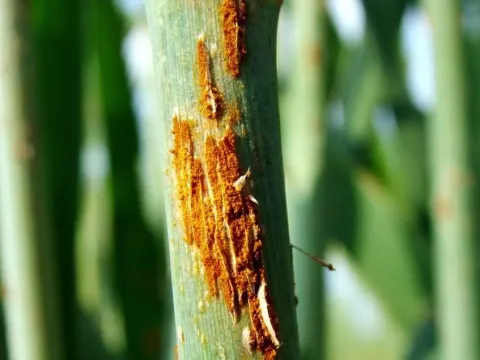
The most distinctive symptom is the appearance of rusty-brown, elongated pustules (uredinia) that break through the surface of stems and leaf sheaths.
These pustules are filled with masses of urediniospores that leave a rusty powder on fingers or clothing when brushed against the infected plant parts.
As the plant matures, the uredinia are replaced or joined by dark, black-colored telia, which contain teliospores and mark the fungus's shift into its dormant phase.
On the alternate host, the barberry plant, the infection manifests as bright orange, cup-like structures known as aecia, which release spores that infect nearby grasses.
Infected plants exhibit generalized chlorosis, stunted growth, and premature senescence, failing to fill their grain properly due to severe resource depletion.
The primary management strategy involves breeding and planting resistant crop varieties that contain effective resistance genes against prevalent local races of the pathogen.
Cultural practices, such as the systematic removal of barberry bushes in the vicinity of cereal fields, help to break the life cycle and reduce primary inoculum.
Proper field sanitation, including the destruction of volunteer cereals and grassy weeds, is essential to remove potential "green bridges" for the fungus.
When environmental conditions favor disease, the application of systemic fungicides, such as triazoles or strobilurins, provides critical protection for the crop.
- Planting resistant wheat and barley cultivars
- Systematic application of fungicides upon early detection
- Removal of common barberry (alternate host) near fields
- Controlling volunteer crops to prevent inoculum buildup
- Strategic timing of planting to avoid peak pathogen pressure