
Stem rust
Puccinia graminis
Stem rust is caused by the fungus Puccinia graminis, an obligate biotroph belonging to the Pucciniaceae family. It is a highly specialized pathogen that affects major cereal crops, including wheat, barley, and oats, and has many formae speciales.
What the section contains
Stem rust
The life cycle is complex and heteroecious, requiring two different hosts: a cereal host for the asexual stage and the common barberry (Berberis vulgaris) as an alternate host for the sexual stage.
Dissemination occurs primarily via urediniospores, which can travel hundreds of kilometers on wind currents. Favorable conditions for infection include moderate temperatures between 18°C and 25°C and high humidity or free moisture on the leaf surface.
The fungus overwinters as teliospores on crop residues or survives in urediniospore form in regions with mild winters. This versatility allows the pathogen to persist across various climatic zones.
Due to its high mutation rate, new virulent races of Puccinia graminis often emerge, posing a constant threat to global wheat production and requiring continuous monitoring.
Stem rust primarily attacks the stems and leaf sheaths of cereal plants. By disrupting the host's vascular system, the fungus significantly reduces the transport of water and nutrients to the developing grain.
Infected plants exhibit stunted growth and reduced grain fill. In severe cases, the grains become shriveled, leading to a massive decline in yield and poor milling and baking quality.
Lodging is a common consequence of stem rust infection because the fungus weakens the integrity of the stem wall. This makes harvesting difficult and often results in additional yield losses.
The disease also reduces the photosynthetic capacity of the plant by disrupting the epidermis, which further hinders the plant's ability to produce the sugars required for grain development.
Economic impact is extreme, as major epidemics have historically caused total crop failures over vast geographical areas, threatening food security in many regions.
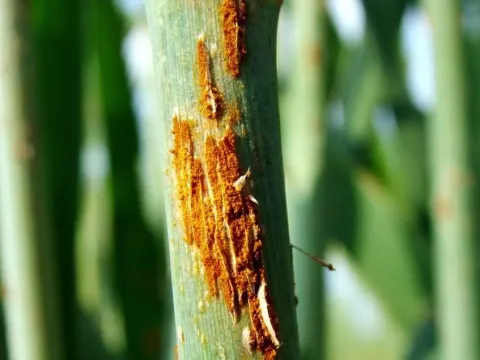
The most recognizable symptoms are the development of reddish-brown, elongated uredinia that erupt through the epidermis of stems, leaf sheaths, and sometimes leaf blades.
As the season progresses, these pustules often turn into black telia. These telia consist of thick-walled teliospores that represent the survival phase of the fungus.
A diagnostic characteristic is the torn appearance of the host plant's epidermis surrounding the pustules. When touched, these pustules release a large amount of rusty-colored spores.
On the alternate host, Berberis vulgaris, the fungus produces pycnia and aecia on leaves in the spring. These structures appear as bright orange spots, which serve as the primary inoculum source for the cereal crop.
During a severe outbreak, large portions of the stem may become covered in pustules, giving the field a brownish or darkened appearance when viewed from a distance.
The most sustainable method for controlling stem rust is the cultivation of resistant or tolerant crop varieties. Plant breeding programs focus on identifying and incorporating R-genes into commercial cultivars.
Cultural practices include the elimination of barberry bushes in the vicinity of agricultural fields and the eradication of volunteer cereals that may act as "green bridges" for the pathogen.
Fungicide application using triazoles and strobilurins is effective in managing active infections. Timing is crucial; applications should ideally begin at the first sign of disease development.
Proper nutrient management, ensuring balanced levels of phosphorus and potassium, helps improve the overall plant health and resilience against fungal pathogens.
- Utilizing genetically resistant wheat cultivars.
- Implementing integrated pest management (IPM) strategies.
- Applying fungicides based on field scouting results.
- Maintaining proper crop rotation and sanitizing field borders.