
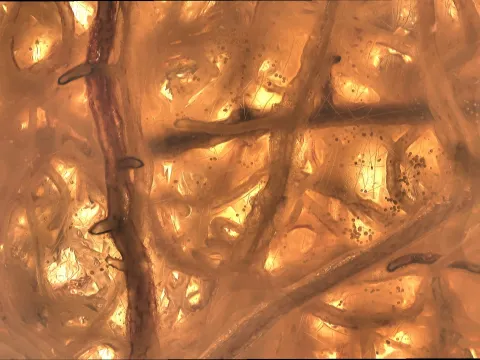
Phoma macrostoma
Phoma macrostoma
Phoma macrostoma is a member of the Fungi kingdom, within the genus Phoma. It is a well-known soil-borne plant pathogen with a global distribution.
What the section contains
Phoma macrostoma
Microscopically, it is identified by the formation of pycnidia, which are spherical fruiting bodies embedded within the host plant tissue. Its conidia are typically hyaline and unicellular.
The fungus is categorized as a facultative parasite, exhibiting both pathogenic behavior on living plants and saprotrophic survival on decaying organic matter in the soil.
It remains viable in the soil for several years by persisting as mycelium and pycnidia within crop residues, soil particles, and contaminated seed stocks.
Its broad host range makes it a persistent agricultural threat, as it spreads easily through wind-blown rain splashes and contaminated farming equipment.
This pathogen affects a vast array of crops, including cereals, oilseeds (like sunflower), vegetables, and ornamental plants. Seedlings are particularly susceptible to infection.
The primary damage involves root rot and stem base decay, leading to damping-off, stunted growth, and potential death of the affected plant populations.
Infection of the foliage manifests as necrotic leaf spots, which merge to cause significant tissue death, thereby reducing the photosynthetic area of the plant.
The overall impact on crop yields is severe, as the pathogen impairs vascular function and nutrient uptake, significantly weakening the plant's overall vitality.
Furthermore, contaminated seeds suffer from reduced germination energy and poor vigor, making them unreliable for planting and further spreading the inoculum.
The pathogen begins its active development in early spring, once soil moisture and temperatures are optimal for the germination of pycnidiospores.
Infection cycles continue throughout the growing season, with precipitation being a key driver for spreading spores from the soil onto healthy plant tissue.
Optimal conditions for infection include temperatures between +15°C and +22°C (59°F - 72°F) accompanied by high relative humidity levels, usually exceeding 80%.
During prolonged dry periods, the fungus enters a quiescent phase, surviving within crop debris until favorable environmental conditions return for disease propagation.
The highest risk for massive outbreaks occurs during rapid vegetative growth, as soft, actively dividing plant tissues are highly vulnerable to fungal penetration.
The initial signs are characterized by dark, often sunken lesions on the lower stem, which eventually develop small black dots representing the pycnidia.
Foliar symptoms include chlorotic spots that rapidly progress into necrotic lesions of irregular shape, often surrounded by a distinct halo or margin.
Root system damage shows as browning and softening of the tissue, leading to root decay and the loss of root hairs necessary for water and mineral uptake.
In seedlings, "black leg" symptoms are common, where the hypocotyl darkens and constricts, causing the young plant to collapse and die rapidly.
- presence of visible black pycnidia on tissues
- concentric zonation patterns on necrotic spots
- wilting and deformation of young plant shoots
- overall reduction in plant stand density
Crop rotation is the most effective cultural practice, as it reduces the pathogen's inoculum levels in the soil by alternating with non-host plant species.
Proper field sanitation, including deep incorporation of crop residues, helps decompose the debris that harbors the fungus, significantly reducing the inoculum load.
Seed treatment using broad-spectrum fungicides is essential for protecting young seedlings from early-season soil-borne infections and damping-off.
If disease symptoms appear during the growing season, timely applications of systemic fungicides, particularly those containing triazoles or strobilurins, are recommended.
Managing nutrient levels is crucial; excessive nitrogen application can lead to lush, succulent growth that is more susceptible to Phoma macrostoma invasion.