
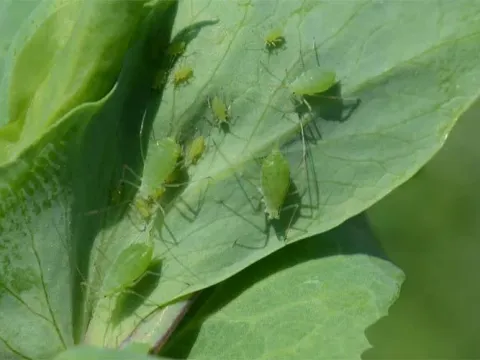
Pea aphid
Pea green
The pea aphid (Acyrthosiphon pisum) is a small insect belonging to the family Aphididae, which is a major pest for many legume crops around the world.
What the section contains
Pea aphid
Adult aphids measure 3-5 mm in length and are typically bright green or yellowish-green, featuring long legs and antennae that distinguish them from other species.
The species exists in both winged and wingless forms, with the winged adults serving the critical function of migrating between plant hosts during the growing season.
The life cycle is largely parthenogenetic, meaning females give birth to live young without mating, allowing for extremely rapid population growth in favorable conditions.
They overwinter as eggs on perennial legumes like clover or alfalfa, ensuring the species survives cold winters to infest new crops in the following spring.
Pea aphids primarily attack plants within the Fabaceae family, including peas, lentils, beans, and alfalfa, causing significant agricultural losses.
They damage crops by piercing the plant tissue with their mouthparts and sucking out the phloem sap, which is essential for the plant's development and nutrient transport.
Beyond the direct loss of plant vigor, the pea aphid is a highly efficient vector for various plant viruses, such as the pea enation mosaic virus.
Severe infestations cause stunted plant growth, leaf curling, flower drop, and poor pod filling, which significantly reduces the quality and yield of the harvest.
In cases of high pest density, aphids can cause the total failure of the crop, making them one of the most economically important pests in legume cultivation.
Activity typically begins in early spring, when temperatures rise above 10°C, triggering the hatching of overwintering eggs on perennial hosts.
Throughout the late spring and summer, multiple overlapping generations are produced, with winged individuals migrating to annual legume crops like peas.
Populations tend to peak during the budding and flowering stages of the plant, as these are the most nutrient-rich phases for the aphids to exploit.
Development is accelerated by warm and dry weather, which allows the population to expand rapidly, while heavy rainfall can naturally suppress numbers.
As autumn approaches, the environmental cues trigger the production of sexual forms, which then mate and lay eggs on perennial plants to survive the winter.
Visible signs of infestation include the curling and distortion of terminal leaves and young stems where the aphid colonies congregate.
The presence of honeydew, a sticky substance excreted by the aphids, often leads to the growth of sooty mold, giving the leaves a black, powdery appearance.
Plants affected by aphid-transmitted viruses may show mosaic patterns, chlorosis, or general yellowing, accompanied by a noticeable lack of vitality.
Inspecting the underside of leaves and the flower buds will reveal clusters of small green insects, which will likely move or drop when disturbed.
Overall decline in the field, often starting at the borders near perennial patches, is a strong indicator of an aphid outbreak in progress.
Effective management begins with cultural practices, such as maintaining spatial separation between annual legume fields and perennial forage crops.
Early sowing can help the crops reach maturity before aphid populations reach their seasonal peak, reducing the duration of susceptibility.
Chemical control via systemic insecticides is necessary when the number of aphids exceeds the established economic threshold for the specific region.
Promoting natural enemies like lady beetles, lacewings, and parasitic wasps is essential for integrated pest management and long-term control.
- Utilizing resistant crop varieties where available.
- Regular monitoring of field edges during the budding stage.
- Applying insecticides only when scouting confirms high aphid density.
- Removing weeds that act as alternative hosts for the aphids.