
Passiflora latent virus
Passiflora latent
Description
How to identify
Passiflora latent virus (PLV) is a plant virus belonging to the genus Carlavirus within the family Betaflexiviridae. It is a widespread pathogen known for its ability to persist in hosts without showing severe external symptoms.
The virus consists of flexuous filamentous particles containing a single-stranded RNA genome. Its life cycle is closely linked to its host, allowing it to maintain long-term systemic infection.
Since the virus is often asymptomatic, reliable identification requires modern diagnostic techniques such as ELISA (Enzyme-Linked Immunosorbent Assay) or RT-PCR.
Mechanical transmission is a common pathway for the virus, occurring through contaminated gardening equipment, pruning tools, or simple contact between foliage.
Insect vectors, particularly aphids, play a crucial role in the dissemination of the virus in the field, moving the pathogen in a non-persistent manner between host plants.
What it damages
The primary host for this virus is the Passiflora genus, including Passiflora edulis (passion fruit), which is an economically significant crop worldwide.
The pathogen can also affect various other plant species, posing a risk to biodiversity and mixed agricultural systems where multiple crops share common insect vectors.
Damage includes reduced plant vigor, decreased fruit yield, and poorer quality of produce, which impacts the economic stability of commercial passion fruit farms.
In cases of coinfection with other plant viruses, PLV can act synergistically to cause severe stunting, leaf deformation, and total crop failure in extreme instances.
The accumulation of the virus in stock plants leads to long-term degradation of germplasm, necessitating regular laboratory testing for all mother plants.
Signs of infestation
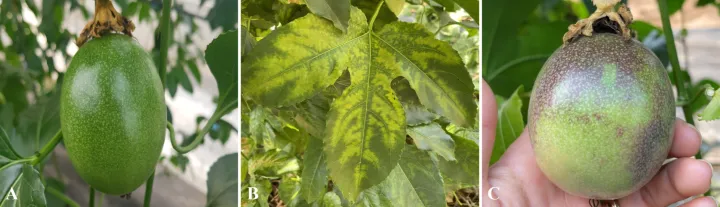
The defining characteristic of this virus is its latency; infected plants often display no visible signs of stress or disease, remaining outwardly healthy.
In some cases, mild mosaic patterns or subtle chlorotic spots on leaves might appear, which are frequently mistaken for nutrient deficiencies or environmental stress.
Under stressful conditions or in the presence of other pathogens, infected plants may show stunted growth, twisted leaves, and shortened internodes.
Symptoms are most visible when the plant is under high environmental pressure, but even then, they are usually mild compared to other viral diseases.
The lack of obvious signs makes it essential for farmers to perform systematic screening rather than relying on visual inspection of the crop.
Control measures
The fundamental strategy for control is the utilization of virus-indexed, certified disease-free propagation material sourced from reputable nurseries.
Stringent sanitation protocols, including the disinfection of pruning tools and equipment using sanitizing solutions, are critical to preventing mechanical transmission.
Effective management of aphid populations through integrated pest management (IPM) practices is necessary to reduce the spread of the virus by insect vectors.
Regular monitoring of plants and immediate rogueing of any specimens showing symptoms or testing positive for the virus are essential to limit secondary spread.
- Utilize certified virus-tested planting stock.
- Implement strict tool disinfection between individual plants.
- Conduct regular monitoring for aphid vectors.
- Establish spatial isolation between nursery and production areas.
- Remove and destroy all suspected virus-infected plants immediately.
Causes diseases · 1
Discussion
No discussions yet — be the first.