
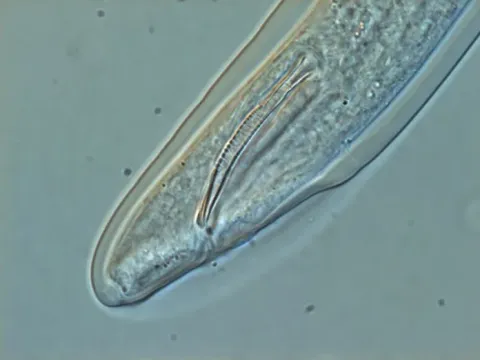
Paratrichodorus minor
Paratrichodorus minor
Paratrichodorus minor is a plant-parasitic nematode belonging to the family Trichodoridae. These organisms are commonly referred to as stubby-root nematodes due to the specific symptoms they cause on the host plant roots.
What the section contains
Paratrichodorus minor
Adult nematodes are microscopic, measuring roughly 0.5 to 1.0 mm in length. Their bodies are relatively stout and cylindrical, which allows them to navigate through the pores of the soil to reach plant roots.
They feed ectoparasitically, meaning they stay outside the root, using a specialized feeding structure called an onchiostyle to pierce root cells and extract nutrients. This feeding behavior causes significant physiological stress to the plant.
Beyond direct feeding, Paratrichodorus minor is a critical vector for several soil-borne plant viruses, most notably the Tobacco Rattle Virus (TRV), which impacts a wide array of agricultural crops.
The life cycle of this nematode is entirely soil-based, involving eggs, four larval stages, and adults. They are highly adaptable to various soil types, particularly sandy soils where their movement is facilitated by larger pore spaces.
This nematode has a very broad host range, including economically important crops such as potatoes, onions, tomatoes, and various turf grasses. It poses a significant threat to global vegetable production.
The primary symptom of damage is the inhibition of root growth. As the nematode feeds on the root tips, the plant responds by halting longitudinal growth, leading to a stunted, "stubby" appearance of the root system.
A reduced root system impairs the plant's ability to absorb water and essential nutrients, leading to secondary symptoms such as yellowing, wilting, and overall stunted growth of the plant's above-ground parts.
When infected with the Tobacco Rattle Virus (TRV) transmitted by P. minor, potatoes exhibit internal necrosis, often called "spraing," which makes the tubers unmarketable and unsuitable for processing.
Infestations typically occur in patches across the field. Farmers often notice irregular crop height and vigor, with affected areas showing severe chlorosis and decreased yield quality compared to healthier neighboring plants.
Paratrichodorus minor populations fluctuate based on soil moisture and temperature. They are most active during the growing season when soil temperatures range between 15°C and 25°C.
In spring, as soil warms, nematodes move towards the rhizosphere of developing seedlings, where they initiate feeding. This makes young plants particularly vulnerable to the initial infection phase.
During extreme heat or cold, these nematodes migrate deeper into the soil profile to avoid unfavorable conditions, effectively surviving until more suitable environmental parameters return.
Water movement, including irrigation and heavy rainfall, is a major factor in the spread of these nematodes across fields, as they are easily carried in water films within the soil matrix.
Agricultural activities such as plowing, harrowing, and the transport of soil on machinery wheels are the primary ways that infestations are introduced into previously healthy agricultural land.
The visual impact of an infestation is often patchy and uneven. Plants in affected areas are noticeably smaller and may show signs of nutrient deficiency despite adequate fertilization.
Plants may show reduced foliage density and paler leaves. In the case of viral transmission, leaves might develop distinct mottling, mosaics, or necrotic spots characteristic of TRV infection.
Root systems are the most telling sign. When carefully excavated and washed, the roots will appear stunted, with thickened, blunt tips that lack the fine root hairs necessary for nutrient uptake.
Potato tubers exhibit surface lesions, internal browning, or corky rings, significantly diminishing the crop value. These internal defects are often only visible upon slicing the tuber.
- Stunted growth of seedlings.
- Patchy distribution of crop failure.
- Stubby, blunt root ends.
- Viral symptoms on leaves.
- Internal necrosis of tubers (spraing).
Crop rotation is the most sustainable management practice. By rotating susceptible crops with non-host plants or cover crops that suppress nematode populations, farmers can reduce soil infestations over time.
Strict phytosanitary protocols are essential. Always utilize certified nematode-free seeds and transplants to prevent the introduction of the pest into clean fields.
Chemical control involving soil fumigation or the use of nematicides is possible, though it is often expensive and subject to strict environmental regulations regarding soil and groundwater health.
Good soil management, including the use of organic amendments, can sometimes improve soil structure and plant vigor, making crops more resilient to the damage caused by Paratrichodorus minor.
Regular sanitation of farm equipment is mandatory. Thoroughly cleaning machinery and tools after working in infested zones is a critical step in containing the spread of the nematode within the farm.