
Pasmo disease of flax
Mycosphaerella linicola
Pasmo disease is caused by the fungus Mycosphaerella linicola (anamorph Septoria linicola). It is a significant phytopathogen belonging to the kingdom Fungi that infects all above-ground parts of flax plants throughout the growing season.
What the section contains
Pasmo disease of flax
This pathogen survives in the soil on infected plant debris and can also be transmitted via contaminated seeds. The fungus is highly adaptive to various weather conditions, making it prevalent in many flax-growing regions worldwide.
The life cycle involves both conidial and ascosporic stages. Conidia are spread by rain splashes and wind to healthy tissues, facilitating the rapid spread of the disease under favorable conditions.
Primary inoculum comes from infected debris, where the fungus overwinters as perithecia. During spring, under moist conditions, ascospores are released and initiate the first infections on young seedlings.
High humidity and moderate temperatures are critical for the development and spread of the disease, making it a persistent challenge in years with high rainfall during the crop cycle.
The disease affects both fiber flax and linseed, negatively impacting yield and quality. The pathogen attacks vegetative organs, including leaves and stems, as well as reproductive structures like capsules.
Infection leads to premature leaf drop, which reduces the photosynthetic area and weakens the plant's overall vigor. This consequently stunts growth and development.
Stem infection disrupts nutrient and water transport, leading to brittle fiber and reduced strength. This significantly decreases the market value of the harvested fiber.
Infection of the capsules results in shriveled, underdeveloped seeds with reduced germination rates. These seeds serve as a vector for transmitting the disease to subsequent crops.
In cases of severe infestation, yield losses can reach 20-30%, or even higher in epidemic years, posing a serious economic threat to commercial flax production.
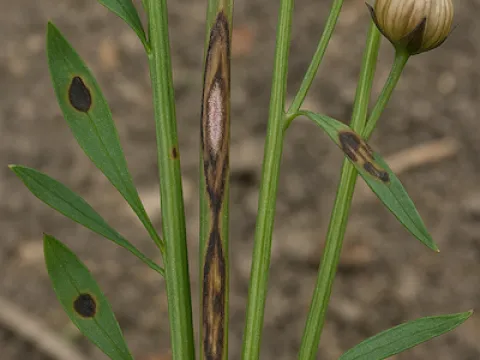
Initial symptoms appear as light brown spots on cotyledons and leaves, which develop a dark border over time. These spots can coalesce, covering large portions of the leaf surface.
Elongated gray or brown lesions develop on stems and peduncles. Within these lesions, tiny dark structures called pycnidia, containing spores, are often visible upon close inspection.
Infected capsules exhibit characteristic dark brown sunken spots. This often leads to deformation, browning, and premature cracking, which negatively impacts seed production.
Under humid conditions, a sparse fungal growth may be visible on the lesions. Infected plants appear stunted, prematurely yellow, and desiccated, creating distinct patches of early senescence.
- Darkening and necrosis of cotyledons.
- Presence of black pycnidia on stems and leaves.
- Brittleness of stems reducing fiber quality.
- Browning and deformity of seed capsules.
The primary control measure is the use of high-quality, certified seed free from the pathogen. Seed treatment with appropriate fungicides is essential to prevent early-season infection.
Strict crop rotation, with at least a 5-6 year interval between flax crops, is fundamental to reducing the pathogen's load in the soil and preventing carry-over infection.
Proper soil management, including deep plowing to bury infected plant residues, accelerates their decomposition and reduces the amount of primary inoculum available for the next season.
During the growing season, if conditions are favorable for disease spread or if initial symptoms appear, systemic fungicides should be applied to protect the crop and limit further spread.
Timely harvest, rapid drying of the crop, and thorough cleaning of the seeds help prevent further colonization of the harvested material and ensure long-term storage quality.