
Ovulinia azaleae
Ovulinia azalea
The causal agent of the disease is the fungus Ovulinia azaleae, belonging to the Kingdom Fungi, Phylum Ascomycota, Order Helotiales. It is a highly specialized parasite that primarily attacks plants of the genus Rhododendron, including azaleas.
What the section contains
Ovulinia azaleae
Systematically, this organism is a cup fungus. Its life cycle is tightly linked to the blooming season of its host plants, making it a highly specific pathogen capable of rapid spread under conditions of high humidity.
To identify the pathogen in laboratory settings, researchers analyze spores formed on the surfaces of infected tissues. In field conditions, the diagnosis is made based on the characteristic necrotic patterns on the petals.
The fungal mycelium penetrates deep into the tissues of the flower, causing rapid degradation of cellular structures. The delicate petals serve as an optimal substrate for the fungus, where it reproduces actively under favorable weather conditions.
During its development, the pathogen forms sclerotia — dense aggregations of fungal tissue that allow it to overwinter in the soil under the shrub. These structures serve as the primary source of infection in the following season.
The primary targets of infection are the flowers of azaleas and various rhododendron species. The disease rarely affects vegetative organs such as leaves or shoots, focusing exclusively on the plant's reproductive parts.
The damage caused by the fungus involves the complete loss of the shrub's aesthetic value during the peak blooming period. Flowers quickly turn brown, lose their shape, and wither, rendering the plants unsuitable for ornamental purposes.
In cases of epidemic development, 100% of the inflorescences on a bush may be destroyed. This not only ruins the garden's visual appeal but also reduces the plant's overall vitality due to the disruption of natural biological processes.
The infection can spread to neighboring plants via rain splashes or insects, leading to the contamination of entire rhododendron collections. The economic impact of the disease is significant for nurseries and professional landscaping.
Long-term consequences of infection include the risk of plant exhaustion if subjected to the pathogen over several consecutive years. This reduces the azaleas' resistance to other environmental stressors.
Active infection development coincides with the azalea blooming period, particularly when air temperatures remain between 15–20 degrees Celsius. Rainy and humid weather acts as a trigger for spore germination.
Initial infections occur at the start of blooming when the fungal apothecia, developing from overwintered sclerotia in the soil, release ascospores. These spores are carried by wind or water droplets onto receptive petals.
Secondary infection occurs very rapidly as the fungus produces conidia on already infected areas. Within a few days of the initial infection, the cycle may repeat multiple times, covering all flowers on the bush.
The pathogen's season ends with the conclusion of the blooming period. The fungus enters a resting stage by forming new sclerotia, which fall along with the withered flowers onto the soil surface.
Thus, the life cycle of the fungus is entirely synchronized with the phenology of the host plant, ensuring its survival in specific ecological niches over extended periods.
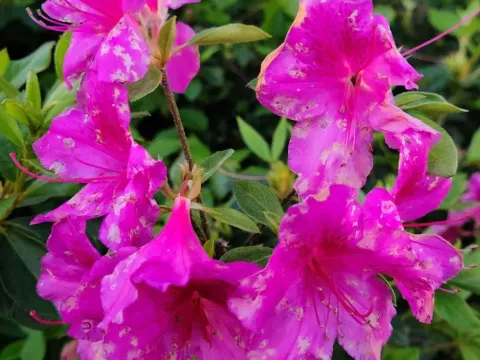
The first signs of infection are small, water-soaked spots on the petals, which expand rapidly in size. Gradually, these spots turn brown or rust-colored.
Infected petal areas become soft, slimy, and translucent. The entire structure of the flower loses turgor and quickly collapses, turning into a brown mass hanging from the branches.
Under high humidity, a whitish or grayish mold consisting of fungal conidia can be observed on the surface of the dead flowers. This is a primary indicator of the parasite's active sporulation.
Later, as the flower dries and mummifies, dark, almost black dense bodies called sclerotia form on its surface. They appear as tiny, flat, hard growths.
The presence of these mummified flowers under the shrub is a key diagnostic sign confirming the presence of Ovulinia azaleae in the garden.
The primary control measure is sanitary pruning and the collection of all fallen flowers and mummies. Removing plant debris from under the bushes significantly lowers the inoculum level for the following year.
It is important to follow agricultural practices that ensure good air circulation within the shrub canopy. Pruning branches and removing excessive growth reduces humidity inside the canopy, which hinders fungal spread.
Mulching the soil under the bushes with a layer of fresh bark or wood chips is an effective method. This prevents spores from escaping the soil, where sclerotia overwinter, and reaching the lower branches of the plant.
The application of chemical fungicides is most effective at the beginning of the blooming period. Systemic fungicides that suppress ascomycete development are used for preventative purposes.
- Regular inspection of plants during the blooming period.
- Prompt removal of the first infected inflorescences.
- Avoidance of overhead watering (wetting leaves and flowers) in the evening.
- Scheduled fungicide application in nursery settings if an epidemic is threatened.