
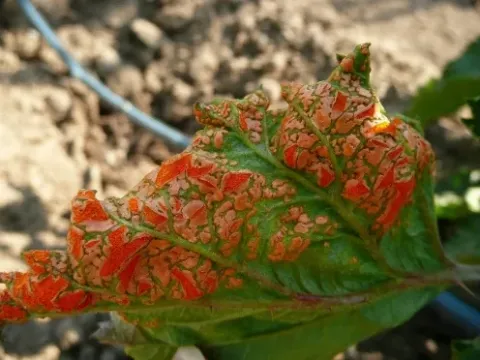
Orange rust of raspberry
Gymnoconia nitens
Orange rust is caused by the systemic fungus Gymnoconia nitens, belonging to the Basidiomycota division. This obligate parasite colonizes the entire vascular system of the host plant.
What the section contains
Orange rust of raspberry
Unlike other rust species that may infect locally, this fungus is systemic. The mycelium persists within the roots and crowns of the plant, ensuring the infection returns every spring as new shoots emerge.
The fungus has a microcyclic development cycle, meaning it does not require an alternate host to complete its life cycle. It produces two types of spores: aecia and telia.
Environmental conditions characterized by cool, wet springs favor the development and dispersal of spores, which are spread by wind, splashing rain, and agricultural equipment.
Taxonomically, it is recognized as a serious pathogen of the Rubus genus, primarily targeting raspberries and blackberries, leading to significant economic losses in berry production.
The disease primarily attacks raspberry and blackberry plants. It is highly destructive because it drains the plant of the resources necessary for fruit production and overall vigor.
Infected plants may initially show signs of growth, but they typically remain stunted, produce fewer or no fruits, and eventually succumb to the systemic fungal colonization.
The presence of the fungus makes the plant commercially useless. Because the pathogen is systemic, it permanently lives within the plant's vascular tissues, rendering any curative chemical treatment ineffective.
Fields with significant infection rates often require complete eradication and a period of crop rotation before the site can be used for raspberry production again.
Yield loss is absolute for infected individual plants, and the spread to neighboring healthy plants can cause an entire patch to fail within a few growing seasons.
Early signs typically appear in spring. The undersides of the leaves develop small, yellow-green spots that soon turn into bright orange, powdery pustules.
The leaves of infected canes often appear distorted, curled, and smaller than those of healthy plants. These symptoms are key indicators of the systemic nature of the infection.
The orange spores eventually erupt through the epidermis of the leaves and stems. As the season progresses, these orange spots can become darker as teliospores are formed.
Young shoots that develop in spring from an infected plant may be spindly and pale. The foliage might display an unnatural yellowish tinge even before the orange spores appear.
During dry weather, touching an infected plant can release a cloud of orange spores, which is a telltale sign of heavy pathogen sporulation.
The primary control measure is immediate sanitation. Infected plants must be dug up, roots and all, and destroyed by burning or disposal far away from the production area.
Scouting for and removing wild Rubus species in the vicinity is crucial, as they serve as a reservoir for the rust spores that can infect commercial fields.
Maintaining good air circulation through proper pruning and weed control helps reduce the moisture levels around the foliage, which inhibits spore germination and infection.
Fungicide applications are generally preventative. While they cannot cure an already systemically infected plant, they can protect healthy plants in the patch from incoming spore loads.
Use only certified, disease-free nursery stock for new plantings to prevent the introduction of the pathogen into your fields, as the rust can be easily carried in asymptomatic plant tissue.