
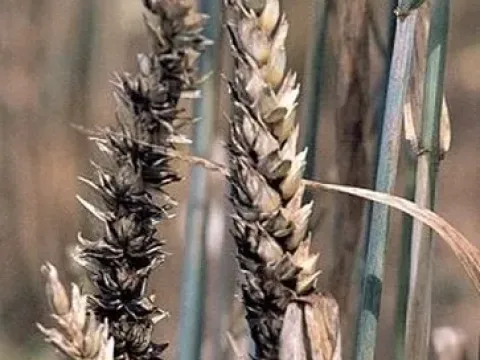
Karnal Bunt
Neovossia indica
Karnal Bunt is a fungal disease of wheat caused by the basidiomycete Neovossia indica (formerly known as Tilletia indica). It is a significant quarantine pathogen that affects bread wheat, durum wheat, and triticale.
What the section contains
Karnal Bunt
The pathogen is characterized by the production of dark brown, globose teliospores with a rough, reticulated surface. These spores are highly resistant to adverse environmental conditions and can survive in the soil for several years.
The fungus belongs to the order Tilletiales. It is a highly specialized pathogen that specifically targets the ovaries of wheat flowers, making it a critical threat to global cereal production.
Field diagnosis relies on detecting a distinct fishy odor, caused by trimethylamine, which emanates from infected heads during the crop's dough stage. This serves as a primary field indicator of the presence of the pathogen.
Laboratory identification involves microscopic examination of spore morphology, soil analysis, and advanced DNA-based diagnostic techniques like PCR, which are essential for official quarantine confirmation.
The disease causes partial or total replacement of the wheat kernel with a black, powdery mass of teliospores. This significantly reduces grain yield and, more importantly, severely degrades grain quality.
Flour produced from contaminated grain becomes discolored and carries an unpleasant, rotten fish odor, rendering it unfit for human consumption. This leads to substantial financial losses for farmers and millers.
Because Karnal Bunt is an international quarantine pest, its detection in a region leads to severe trade restrictions. Many countries enforce a zero-tolerance policy for this fungus, blocking exports from infested areas.
While the disease does not usually cause the total death of the plant, its economic impact is massive due to the loss of market access and the high costs associated with quarantine compliance and decontamination.
Contaminated equipment and harvest machinery can further spread the spores, creating new infection cycles in previously clean fields if rigorous hygiene protocols are not followed.
The infection cycle is highly dependent on environmental conditions during the wheat flowering stage. Optimal temperatures for the fungus are between 15°C and 20°C, combined with high humidity.
Rainfall or high humidity during the boot and anthesis stages is crucial for the germination of teliospores in the soil, which leads to the production of sporidia, the primary inoculum for the spikes.
Sporidia are disseminated by wind or splashing rain to the wheat heads. Once they land on the spikes, they infect the floral tissues, initiating the colonization process within the developing grain.
Hot and dry weather during the flowering period is unfavorable for the disease, which explains why the incidence of Karnal Bunt varies significantly between different geographic regions and growing seasons.
The pathogen completes its cycle as the grain matures. The teliospores produced inside the grains are released during harvest, returning to the soil and completing the multi-year survival loop.
Symptoms are often difficult to detect until the grain is nearly mature. Infected heads may show slightly splayed glumes, allowing the black spore mass to be partially visible.
Unlike other bunt diseases, Karnal Bunt typically affects only a portion of the kernels within a single spike, and often only a portion of an individual kernel is consumed by the fungal mycelium.
The presence of the disease is easily confirmed by the odor of trimethylamine, which intensifies as the grain moisture increases or when the grain is mechanically disturbed during processing.
Upon crushing an infected kernel, the characteristic black, sooty powder is released. These spores leave visible dark smudges on hands, clothing, and machinery, acting as a clear indicator of contamination.
Affected grains are brittle and easily shattered, which causes the spores to contaminate the healthy grain in the harvester and transport vehicles, further complicating harvest logistics.
The primary control strategy is strict quarantine enforcement and the use of certified, pathogen-free seeds. Ensuring that planting material has been tested is the most effective way to prevent the introduction of the fungus.
Crop rotation is a vital management tool, as it helps reduce the soil-borne inoculum level over time. Leaving the field fallow or planting non-host crops for at least 3-4 years is generally recommended.
Fungicide application during the flowering stage can reduce the incidence of the disease, although timing is critical. Applications must coincide with the peak release of sporidia to be effective.
Developing resistant wheat varieties is the ultimate goal of research programs, but currently, high levels of resistance are not widespread, making integrated pest management essential.
Field hygiene, such as deep plowing to bury spores, cleaning machinery between fields, and avoiding the movement of contaminated grain, is crucial for limiting the spread in endemic areas.