
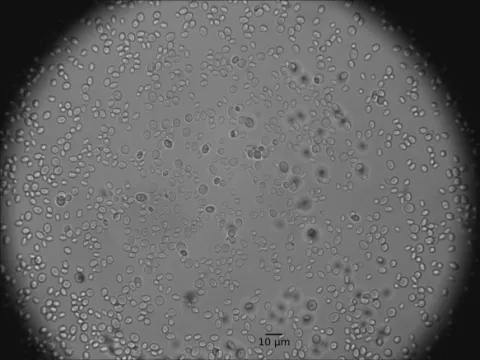
Kloeckera apiculata
Kloeckera apiculata
Kloeckera apiculata (synonym Hanseniaspora uvarum) is an asporogenous yeast species belonging to the Saccharomycodaceae family. It is a unicellular organism that transitions into the Hanseniaspora stage during its lifecycle, producing spores in asci.
What the section contains
Kloeckera apiculata
Cells typically exhibit a distinct lemon or elliptical shape, serving as a primary diagnostic feature under a microscope. These yeasts reproduce by polar budding, often forming chains or clusters on the surface of substrates.
This yeast is a common epiphyte, dominating the microbial population on the skin of grapes, pome fruits, and stone fruits. It is highly adapted to environments rich in sugars with low pH levels.
The organism does not produce true mycelium, instead existing as individual cells or dense colonies. Its high metabolic rate allows it to thrive in various orchard and vineyard ecosystems.
Laboratory identification involves culturing on selective media, where colonies appear creamy and produce a characteristic ester-like odor, distinguishing them from filamentous fungi.
The primary damage caused by Kloeckera apiculata is enzymatic rot in ripe fruits and berries. The pathogen acts as an agent of sour rot, particularly in vineyards and orchards.
The yeast enters fruits through micro-wounds or damage caused by insects and birds. Once inside, it initiates rapid fermentation of the fruit sugars, leading to a complete loss of fruit quality.
In post-harvest conditions, this pathogen is responsible for significant losses in storage. Affected fruits become soft, discolored, and emit a strong smell of fermentation or acetic acid.
The metabolic activity of the yeast breaks down the structure of fruit tissues, making the produce unsuitable for fresh consumption or industrial processing, such as winemaking or juice production.
Furthermore, the presence of these yeast colonies can disrupt the natural microbial balance on the fruit surface, suppressing beneficial microorganisms and promoting secondary bacterial infections.
The peak activity of the pathogen occurs during the ripening phase of fruits and berries, typically spanning from mid-summer to late autumn.
Warm and humid weather conditions are highly conducive to the proliferation of Kloeckera apiculata. During such periods, the population size on the surface of berries increases rapidly.
Harvest time represents the period of highest risk for infection spread. Any mechanical damage occurring during picking provides an entry point for the yeast to colonize the fruit interior.
During the winter, the yeast survives in the soil, fallen leaves, and bark crevices of trees, maintaining viability until the return of favorable environmental conditions.
In spring, as sap flow begins and new plant growth appears, the yeast starts to re-colonize plant surfaces, setting the stage for subsequent fruit infection as the season progresses.
The first visual signs of infection include the appearance of sticky, moist patches on the fruit skin. These spots are often associated with the leakage of fruit juice due to tissue breakdown.
As the disease progresses, a distinct smell of ethyl alcohol or vinegar is often detectable, signaling intense fermentation occurring within the fruit flesh.
A whitish or grayish layer may form on the surface of the lesions, consisting of a dense mass of yeast cells; this layer is non-filamentous and easily wiped off compared to true molds.
The internal flesh of the fruit rapidly loses its firmness and turns into a watery mass, often accompanied by the release of gases during the advanced stages of fermentation.
On grape clusters, infection manifests as the shriveling and browning of individual berries, which eventually wither and serve as a source of inoculum for neighboring healthy berries.
Effective control relies primarily on good agricultural practices. Regular sanitary pruning and the removal of mummified fruits from trees are essential to reduce the inoculum reservoir.
Minimizing pest damage is critical, as insects and birds provide the primary pathways for yeast entry into fruit tissues. Protecting the crop is a key preventative measure.
Ensuring proper airflow and light penetration in the tree canopy helps reduce humidity, making the environment less hospitable for yeast colony development.
Post-harvest management involves maintaining low temperatures in storage facilities to significantly slow down the metabolic activity of the yeast cells.
- Application of broad-spectrum fungicides during the ripening period.
- Careful harvesting to minimize mechanical injuries.
- Rigorous disinfection of storage containers and processing equipment.
- Removal and destruction of fallen fruit (mummies) from the orchard floor.