
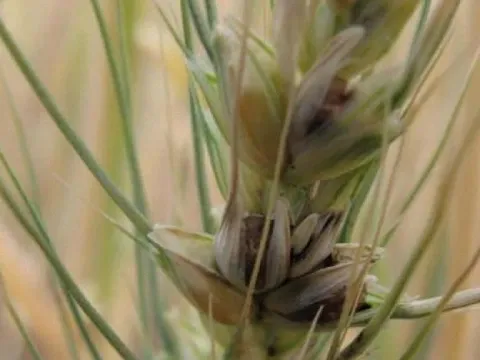
Japanese wheat flag smut
Japanese wheat
Japanese wheat flag smut is caused by the fungus Urocystis agropyri. It is a member of the kingdom Fungi, phylum Basidiomycota, and order Urocystidales.
What the section contains
Japanese wheat flag smut
The pathogen is a systemic parasite that primarily affects wheat plants. It survives in the soil as teliospores, which remain viable for several years waiting for a suitable host.
The fungus specializes in attacking the grass family. Its biological cycle involves infecting the coleoptile of the seedling during germination, followed by systemic mycelial growth.
Teliospores are organized into balls (sori) composed of fertile spores surrounded by sterile cells. These structures provide protection against environmental stress and desiccation.
Environmental conditions such as cool temperatures and high soil moisture at the time of seedling emergence are critical for the successful infection process of the fungus.
The disease causes significant damage by reducing the plant's overall vigor and yield potential. Infected plants often exhibit severe stunting and abnormal growth.
A common symptom is increased tillering, but these tillers rarely produce grain. The stems are usually twisted and malformed, leading to lodging issues in the field.
Economic losses are driven by total grain loss in infected plants. In cases of high inoculum density in the soil, yield losses can be substantial for wheat producers.
The pathogen negatively impacts the plant's ability to survive winter or drought conditions by depleting nutrient reserves needed for healthy development.
In addition to yield loss, the presence of smut spores on the grain reduces its market quality and requires thorough cleaning before processing or distribution.
The most distinctive signs are long, linear stripes appearing on leaves and leaf sheaths. Initially, these stripes are pale, but they eventually turn gray and black.
As the plant tissues mature, the epidermis ruptures to release a black, dusty mass of spores. This spore mass is easily dispersed by wind and field equipment.
Infected plants are noticeably shorter than healthy ones. Severe twisting and curling of stems and leaves are typical indicators of flag smut infection.
Heads are often stunted, deformed, and may fail to emerge from the leaf sheath. If they emerge, they are usually filled with spore masses instead of kernels.
Field inspection usually reveals localized patches of diseased plants. Examining the dark streaks under the leaf surface with a lens confirms the presence of the fungus.
Seed treatment with systemic fungicides is the primary and most effective method to prevent early-stage infection during the germination phase.
Implementing a proper crop rotation system is essential for managing soil-borne inoculum. Avoid planting wheat in the same field for at least three to four years.
The use of resistant or tolerant wheat varieties is a key component of integrated pest management, effectively reducing the impact of the pathogen on crop yields.
Cultural practices like optimal planting dates and good soil drainage help the seedlings establish quickly, reducing the window of susceptibility to the fungus.
Deep plowing can bury the spores deep in the soil, where they are less likely to come into contact with the germinating seeds, thereby reducing the infection rate.