
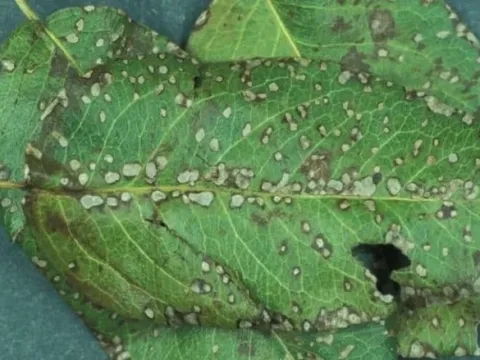
Pear leaf spot
Mycosphaerella sentina
The causative agent of pear leaf spot is the fungus Mycosphaerella sentina (anamorph Septoria piricola). This ascomycete fungus is a significant pathogen that targets the foliage of pear trees globally.
What the section contains
Pear leaf spot
The pathogen overwinters within the tissues of fallen leaves, primarily as pseudothecia or pycnidia, which serve as the primary inoculum for the spring season.
Throughout the vegetative stage, the fungus spreads via conidia dispersed by rain splashes or wind to healthy leaf surfaces, facilitating secondary infections.
Identification is facilitated by observing small, black, dot-like pycnidia clustered within the central, necrotic zones of the leaf lesions.
The development of the disease is highly favored by moderate temperatures and extended periods of leaf wetness, often associated with frequent rainfall.
The disease primarily affects pear species, significantly reducing the tree's photosynthetic capacity by causing premature defoliation in mid-to-late summer.
As leaves drop early, the tree fails to accumulate sufficient energy reserves, leading to reduced winter hardiness and increased susceptibility to freeze damage.
Continuous infections over several years weaken the overall tree structure and vigor, eventually leading to diminished fruit quality and lower yields.
Stunted growth and lower fruit sugar accumulation are common long-term consequences observed in orchards with heavy, unmanaged fungal infestations.
In severe cases, the tree may attempt to produce new leaves late in the season, further depleting its metabolic reserves and compromising survival.
Initial symptoms present as small, dark brown spots that gradually transition to a light gray or white color in the center while maintaining a dark, distinct border.
These spots are initially circular or angular and may merge to cover large sections of the leaf, eventually causing the entire leaf to wither.
The appearance of black pycnidia in the center of the white spots is the hallmark diagnostic feature of this fungal pathogen on pear foliage.
Severe infection leads to widespread chlorosis and premature leaf drop, often giving the canopy a sparse and unhealthy appearance by late summer.
- Dark brown spots on leaves appearing early summer.
- Formation of characteristic black pycnidia in the lesions.
- Premature leaf senescence and early defoliation.
Sanitation is the cornerstone of management: all fallen leaves must be raked and destroyed or buried to eliminate the primary overwintering source.
Cultural practices such as proper pruning improve air circulation within the canopy, reducing the leaf-wetness duration required for spore germination.
Chemical control programs typically involve the application of fungicides during the pre-bloom and post-bloom stages to suppress initial infection cycles.
Monitoring for the first appearance of lesions is critical; timely intervention prevents the buildup of secondary inoculum that causes major defoliation.
Integrating chemical treatments with orchard hygiene significantly reduces disease pressure, ensuring the trees maintain healthy foliage until natural dormancy.