
Pear scab
Venturia pirina
Description
How to identify
Pear scab is a fungal disease caused by Venturia pirina, an ascomycete fungus. Unlike the closely related apple scab (Venturia inaequalis), this pathogen is highly host-specific, infecting only pear trees (genus Pyrus). It is a major economic threat to pear production worldwide.
The fungus overwinters primarily as mycelium in infected twigs or as pseudothecia on fallen leaves. In the spring, during wet conditions, these structures release ascospores into the air. These spores are carried by wind and rain splashes to initiate the primary infection on young, susceptible tissues.
Once established, the fungus produces conidia, which are responsible for secondary infection cycles throughout the growing season. High humidity and cool-to-moderate temperatures are ideal for spore germination and colonization. A film of water on the leaf surface is strictly required for the spores to germinate.
The fungus develops subcuticularly, forming a dense mycelial mat that ruptures the host epidermis. This process creates the characteristic dark, velvety patches of sporulation. These secondary infections can spread rapidly within a canopy if favorable environmental conditions persist for several days.
Understanding the life cycle is crucial for effective management. Because the fungus survives the winter in both leaf litter and woody tissues, sanitation and well-timed fungicide applications are the two pillars of a successful integrated pest management program against this destructive pathogen.
What it damages
The disease affects all aerial parts of the pear tree, including leaves, flowers, fruit, and young shoots. Infections in the early stages of the season are the most damaging, as they often lead to severe physiological stress and reduce the tree's overall vigor and yield potential.
Leaves infected with Venturia pirina develop dark, olivaceous spots. Severe infections lead to premature yellowing and leaf drop. This premature defoliation weakens the tree, reducing its ability to store carbohydrates, which can negatively impact the development of fruit buds for the following year.
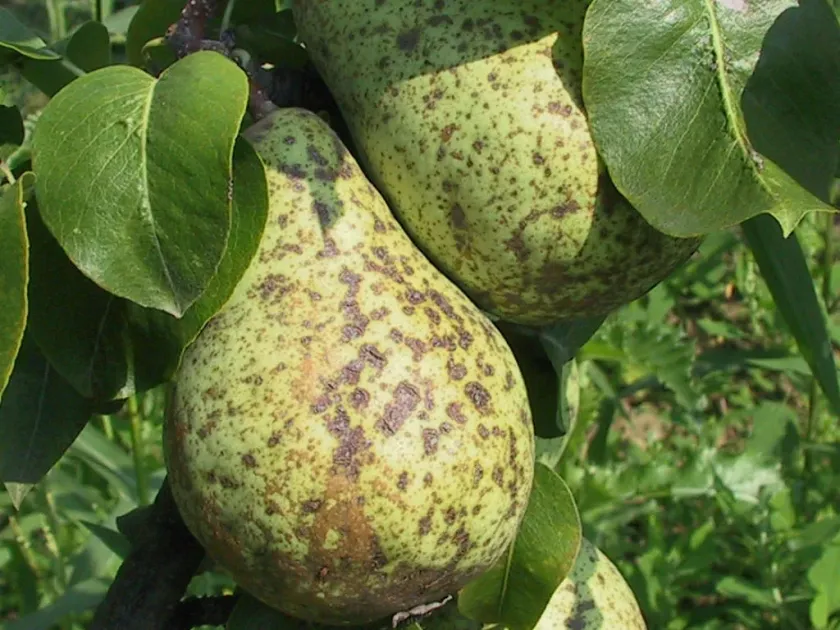
Fruit infection is the most economically significant damage. Affected fruits exhibit scab-like lesions that become corky as the fruit expands. This growth restriction causes the fruit to become deformed, cracked, and stunted, rendering it unsuitable for fresh market sale or long-term storage.
The infection of pedicels often causes the flowers or young fruitlets to abscise and drop from the tree. This early loss can significantly diminish the total harvest. Furthermore, cracks on the fruit surface serve as entry points for secondary pathogens, such as Botrytis or Monilinia.
Twig infection is particularly problematic because the fungus can survive there as a canker. These cankers produce spores in the following spring, providing a local source of inoculum that can infect the new season's growth from within the canopy, making the disease harder to eradicate.
Signs of infestation
Early symptoms appear as pale, irregular spots on the undersides of young leaves shortly after bud burst. As the fungus matures, these spots darken and become covered with a velvety, olive-green mass of conidia. These lesions are easily visible and indicate active sporulation.
On the fruit, lesions start as small, dark, circular spots. As the fruit grows, the lesions enlarge and develop a characteristic corky center. In severe cases, the entire surface of the fruit may be covered in scab lesions, leading to complete deformation and cracking of the fruit skin.
- Olive-green, velvety fungal growth on the underside of leaves.
- Dark, circular, corky lesions on developing pear fruit.
- Deformation, cracking, and stunting of fruit.
- Premature defoliation and leaf yellowing in mid-summer.
- Cankers, blisters, or cracking on young, one-year-old shoots.
It is important to note that environmental conditions greatly influence the visibility of signs. During prolonged dry spells, the fungus may become dormant, and no new lesions will appear. However, the fungus is not eliminated and will resume sporulation immediately when rainfall returns.
Monitoring should focus on the interior of the tree canopy, where humidity levels are typically higher. Inspecting the underside of leaves and the bases of fruitlets during the early post-bloom period is the best way to detect the onset of an infection cycle early.
Control measures
Cultural control begins with orchard sanitation. Raking and removing or shredding fallen leaves during the autumn and winter is essential, as this destroys the primary inoculum source. Additionally, pruning out twigs displaying scab cankers helps reduce the resident fungal population.
Chemical control relies on protective and systemic fungicides. Spray programs should be initiated at the 'green tip' stage. Subsequent sprays are essential during the bloom and petal fall stages, especially during wet periods. Rotating fungicide classes is vital to prevent the development of pathogen resistance.
Maintaining a well-pruned, open canopy is a highly effective management strategy. Proper tree spacing and pruning allow for better air circulation and sunlight penetration, which helps dry the foliage quickly after rain, thereby reducing the time available for spore germination.
Balanced fertilization is also important. Excessive nitrogen encourages succulent vegetative growth, which is highly susceptible to infection. Maintaining healthy tree nutrient levels through proper potassium and phosphorus management helps the plant tissue build stronger cell walls against fungal penetration.
Planting resistant or tolerant pear cultivars is the most sustainable approach for long-term control. While no cultivar is entirely immune, selecting varieties with high resistance can drastically reduce the reliance on synthetic chemicals and simplify orchard management significantly.
Causes diseases · 1
Discussion
No discussions yet — be the first.