
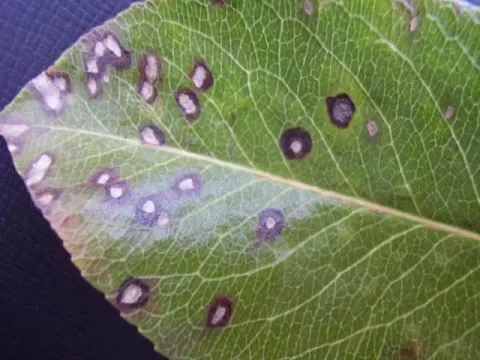
Pear Mycosphaerella leaf spot
Mycosphaerella pyri
The disease is caused by the fungus Mycosphaerella pyri (anamorph Septoria pyricola), which belongs to the family Mycosphaerellaceae.
What the section contains
Pear Mycosphaerella leaf spot
The pathogen primarily overwinters as perithecia on fallen pear leaves, which release ascospores in the spring during rainy weather.
Secondary spread occurs through conidia that are disseminated by rain splash and wind, infecting healthy foliage during the summer months.
The life cycle is highly dependent on humidity levels; prolonged leaf wetness is essential for successful spore germination and infection.
It is classified as a significant foliar pathogen that thrives in temperate climates where pear orchards are intensively cultivated.
Mycosphaerella pyri primarily affects pear trees (Pyrus spp.), leading to premature defoliation, which weakens the overall tree vigor.
By reducing the photosynthetic area of the leaves, the disease significantly impairs the tree's ability to store energy for the subsequent growing season.
Trees affected by severe leaf spot often show reduced cold hardiness, making them more susceptible to winter damage in cold climates.
Crop quality and fruit size can be compromised because the tree cannot mobilize enough nutrients to support optimal fruit development.
In nursery settings, heavy infestation can stunt the growth of young saplings, rendering them unsuitable for orchard planting.
Infection begins as small, irregular, or circular spots on the leaves, which gradually increase in size and turn light brown or ash-colored.
A distinctive feature is the development of tiny, black, pimple-like structures called pycnidia scattered within the center of the spots.
Affected leaves may turn yellow and drop prematurely, often leaving the branches bare before the natural end of the growing season.
The lesions are clearly defined, often surrounded by a darker border, and can coalesce to cover large areas of the leaf surface.
While the fruit is generally not directly infected by this pathogen, the stress caused by severe defoliation can lead to indirect fruit quality issues.
Sanitation is the primary control strategy; removing and destroying leaf litter is essential to eliminate the overwintering inoculum source.
Pruning trees to improve canopy airflow helps to reduce humidity levels, which effectively creates a less favorable environment for fungal growth.
Fungicide programs should be timed based on infection periods and local weather conditions, prioritizing preventive applications early in the season.
Integrated Pest Management (IPM) practices, including proper nutrient balance, help trees maintain natural resistance to foliar pathogens.
- Removal of infected foliage.
- Canopy thinning for ventilation.
- Application of broad-spectrum fungicides.
- Monitoring for early symptoms.